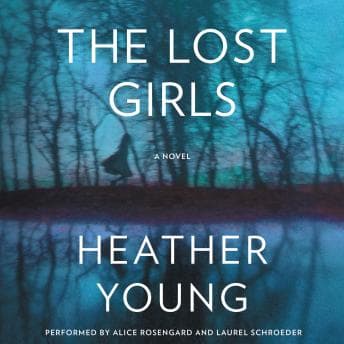

Okay, I need to talk about the marketing on this book because someone somewhere decided to pitch it as a psychological thriller and I went in expecting missing-child suspense and what I got was - well, not that. Not exactly. And I'm a little irritated about it because if someone had just TOLD me this was quiet literary fiction about generational grief wrapped around a lake house mystery, I would've been mentally prepared instead of spending the first three hours going "when does the thriller part kick in?"
But here's the thing. Once I stopped waiting for it to be something it wasn't, I kind of fell into it. Hard.
Two Women, One Lake, Seventy Years of Silence
The structure alternates between two timelines and two narrators - Alice Rosengard handles Justine's present-day chapters and Laurel Schroeder voices Lucy's 1935 diary entries. Lucy is the middle sister who watched her younger sibling Emily vanish from their family's Minnesota lake house and then spent the rest of her life sitting in that house like a monument to guilt. Justine is Lucy's grandniece who inherits the place and drags her two daughters there to escape an abusive boyfriend.
The Lucy chapters are where this book really lives. Schroeder reads those diary entries with this low, careful melancholy - like Lucy is choosing every word knowing someone will eventually read them and judge her for what she did and didn't do in the summer of 1935. There's a restraint in the performance that actually works for the character, because Lucy IS restrained. She's the quiet middle child who saw everything and said nothing, and you can hear that caution in how Schroeder paces the lines.
Rosengard's Justine chapters are warmer but also more frantic - which makes sense because Justine is basically me on a Tuesday. Single mom, two kids, one of whom is spiraling, an ex who won't let go, and a mother who shows up uninvited to try to steal her inheritance. (The mother character, by the way? I have never wanted to reach into a book and shake someone so badly. The audacity of that woman.)
This Is Not a Fast Book and That's the Problem and Also the Point
At 12 hours and 36 minutes, this is a commitment. And it's slow. I'm not going to sugarcoat that. There are stretches - particularly in the middle third - where Lucy's diary entries start to feel like circling. She's reflecting on her sister Lilith's cruelty, on her father's distance, on her own paralysis, and you're thinking "I KNOW, Lucy, I know, but WHAT HAPPENED TO EMILY."
I listened to most of this during Sophie's nap times over about nine days, and the pacing actually worked okay in those chunks. Twenty to forty minutes at a time, then pause, come back. The dual timeline structure means there are natural breaking points and the chapters are short enough that I rarely had to stop mid-scene. Survived 47 pauses and still made sense - genuinely. The two narrators help too because even if I forgot exactly where I left off, I could immediately tell which timeline I was in based on the voice.
But if you're someone who needs plot momentum to stay engaged? You might struggle. The Emily mystery is less whodunit and more - why-did-nobody-talk-about-it. The revelation near the end isn't some shocking twist. It's quiet and sad and inevitable in the way real family tragedies are. When the truth finally comes out about what happened at that lake, I was sitting in my car in the garage and I just... sat there. It's not a gotcha moment. It's a grief moment.
Made me cry at school pickup. Worth it though. (Well technically I cried in the garage BEFORE pickup but the red eyes were still visible at the school and Emma asked if I was okay and I said allergies. Classic.)
The Book That Beach-Read Marketing Forgot
Here's my comparison: if you loved The Lake House by Kate Morton or even Before We Were Yours by Lisa Wingate, this lives in that same neighborhood - dual timeline, family secrets, atmospheric setting. But it's quieter than either of those. Less polished, more raw in places. Heather Young was a lawyer who went back for an MFA and you can feel both of those things - the precision of the prose and the emotional weight she's willing to let just SIT there without resolving neatly.
The ending is satisfying but not tidy. Justine gets something like hope. Lucy gets something like peace. Emily gets - well. You'll have to listen.
Not groundbreaking, but sometimes you don't need groundbreaking. Sometimes you need a book that understands how families break each other slowly, over decades, through silence rather than violence. And how the women in those families carry everything. That same weight - women holding the wreckage of their families together across generations - is exactly what George Eliot was doing in Daniel Deronda, and honestly the emotional toll of reading both is not dissimilar.
Who Gets the Keys to the Lake House
This is for you if: you like literary fiction disguised as mystery, you have patience for slow pacing with emotional payoff, and you don't mind being a little wrecked by the end. My book club will love this (if I ever have time for book club again).
Skip it if: you want an actual thriller, you need things to happen quickly, or you're in a season of life where stories about children in danger hit too close. Content warning on that front - it's not graphic but the premise involves a missing child and there's domestic abuse in Justine's storyline that's handled realistically, which means it's uncomfortable.
I'd recommend 1.25x speed, especially through Lucy's middle chapters. It keeps the momentum without losing the atmosphere.