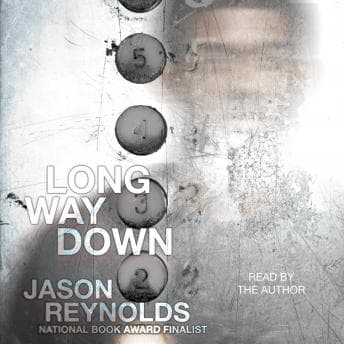

I finished this entire audiobook between San Francisco and Palo Alto.
Seriously. It's 1 hour and 44 minutes. That's shorter than my morning stand-up meeting usually drags on (don't tell my manager). I put this on expecting a quick distraction while debugging some code in my head, and instead I ended up staring out the window at the Baylands, completely forgetting to check my Slack notifications.
Here's the deal: Long Way Down isn't really a "book" in the traditional sense. It's a sixty-second elevator ride stretched into a hundred minutes of audio. It's poetry. It's violent. And it's probably the most efficient storytelling I've heard all year.
When the Dev Writes the Documentation
Usually, I have a strict rule: Authors should write, and professional narrators should read. It's like full-stack engineers—rarely is someone actually good at both backend and frontend.
But Jason Reynolds? He's the exception that breaks my rule.
Since this is written in verse—staccato, rhythmic, slam-poetry style—it needs a specific cadence. If a standard narrator read this, they'd probably try to smooth it out. Make it sound like prose. Reynolds reads it with this breathless, jagged rhythm that makes you feel like you're the one hyperventilating in a metal box.
His voice is deep, textured, and frankly, he sounds tired. Not sleepy-tired, but soul-tired. It fits. The guy is narrating a story about a kid with a gun in his waistband deciding whether to ruin his life. A polished, "radio voice" would've ruined the vibe. Reynolds sounds real.
The Infinite Loop on the Elevator
The premise is basically a logic gate stuck in a loop.
Will's brother is dead. The "Rules" say Will has to kill the guy who did it. He gets on the elevator at the 7th floor. He's going down to the lobby. At every floor, the elevator stops. Someone gets on.
Here's the glitch: Everyone who gets on is dead.
It's basically a debugging session for his conscience. Each ghost is a breakpoint in his code, forcing him to pause and check his variables. Is this really what you want to do? Do you even have the right target?
(I may be over-intellectualizing this to avoid talking about how sad it is, but bear with me.)
The sound design is subtle but effective. You feel that claustrophobia. The pause between floors. The smoke. It's atmospheric without being distracting.
High ROI on Emotion
Look, I listen to 50+ books a year. Most of them are bloated. They could lose 100 pages and nobody would notice.
Long Way Down is zero-bloat. Pure signal, no noise.
Some people in the reviews complain it's "too short" or that they didn't have time to "bond" with the characters. I disagree. You don't need 15 hours of backstory to understand grief. The brevity is the point. A gunshot happens fast. A bad decision happens fast. The book moves at the speed of a panic attack.
It's intense, though. I usually listen at 1.75x speed because I'm impatient. I had to drop this down to 1.0x. You need the silence between the words. If you speed-run this, you're missing the data.
Who This Is For (and Who Should Skip)
Perfect for short commutes or long runs where you want to be angry at the pavement. Skip it if you need something uplifting before a client presentation—it leaves you feeling a little hollowed out.
Closing the Loop
Is it a happy listen? God no. It's bleak.
But is it worth your time? Absolutely. The ROI on this is massive. You get a complete, gut-wrenching narrative arc in less time than it takes to watch a Marvel movie. If you're looking for another quick listen that packs a punch, How to Live on Twenty-Four Hours a Day is similarly efficient—though way less violent and way more about optimizing your actual life.
(And yes, the ending is ambiguous. It's a return statement with no value. It drove me crazy for about ten minutes, and then I realized it was perfect.)









