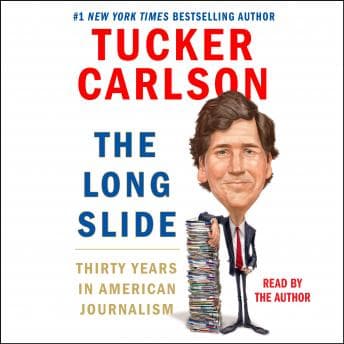

Tucker Carlson is not a novelist. He's not a memoirist in the traditional sense. And this is not, strictly speaking, a book. It's a scrapbook — a curated collection of magazine pieces spanning three decades, stitched together with new annotations that amount to Carlson watching his younger self from the cheap seats and occasionally heckling.
I need to say something upfront: I'm a high school English teacher in Chicago. My politics and Carlson's don't share a zip code. But I've spent twenty years telling teenagers that reading people you disagree with is the whole point of literacy. So when I saw this sitting in my Audible library — six hours and change, author-narrated, a collection of journalism pieces — I figured it was time to practice what I preach. I started it during a Saturday lakefront walk with Denise. She raised an eyebrow at the voice coming through my speaker. I told her it was research. She didn't believe me. Fair.
The Magazine Writer They Don't Tell You About
Here's what surprised me, and I genuinely didn't expect to be surprised: the early stuff is pretty good. The piece about the baked bean factory — Carlson wandering through a second-shift operation somewhere in New England, documenting the rhythms and eccentricities of blue-collar work with actual curiosity — reads like the kind of feature writing I assign my AP students as models of the form. There's an eye for the absurd detail, the telling gesture. The piece on rural western Maine has a quietness to it that feels almost Wendell Berry-adjacent, this attention to place and the people shaped by it.
And the Liberia piece — traveling to West Africa with Al Sharpton and Nation of Islam members to, of all things, try to stop a civil war — is genuinely wild. It's gonzo-lite. You can hear Carlson's bemusement in the narration, this sense that he knows he's stumbled into a situation more bizarre than anything he could've invented. If a student handed me that essay, I'd give it an A and ask what else they'd written.
The problem is that you can feel the magazine writer gradually disappearing as the collection moves forward in time, replaced by something more rigid. The annotations — the "new commentary and insight" promised in the description — are where this happens most visibly. Early annotations are reflective, even self-deprecating. Later ones read like warmup notes for a monologue. The shift is subtle but unmistakable. It's like watching someone's handwriting change over the years and realizing the hand got heavier.
When the Author Is the Narrator and the Subject
Carlson narrating his own work presents an interesting problem. He reads well — his pacing is natural, his delivery is conversational in a way that suits essay-form journalism. He's been talking into microphones for thirty years, and it shows. There's no stumbling, no awkward pauses, no sense that he's fighting the text.
But — and this is the thing — when you narrate your own retrospective collection with added commentary about how right you were, the performance becomes a kind of editorial in itself. A professional narrator might've given these pieces room to breathe on their own terms. Carlson's annotations and delivery sometimes crowd the original writing, turning pieces that were once observational into exhibits in an argument about cultural decline. The James Carville piece, for instance, has this unexpected warmth — Carlson clearly finds the man genuinely charming — but the framing around it keeps nudging you toward a thesis about what we've lost. The piece was already saying that. It didn't need the nudge.
At six hours and twenty-three minutes, it's a quick listen. Almost too quick. Some of these pieces deserved more space, more annotation, more of the curiosity that made them good in the first place.
Who Gets the Assignment
If you're a Carlson fan, you'll love this. That's obvious. But here's the less obvious audience: anyone interested in American magazine journalism from roughly 1995 to 2015. The form itself — the long-form reported feature, the first-person travel piece, the profile that's really about the profiler — is worth studying regardless of who's holding the pen. I'd genuinely consider assigning two or three of these pieces to my students alongside Gay Talese and Joan Didion. (My students would hate this. I love it.)
If political commentary makes your blood pressure spike in either direction, maybe skip. This isn't a book that wants you to be neutral. It knows what it thinks.
And if you're looking for a literary audiobook experience — something where narration transforms the text — this isn't that. It's a guy reading his own articles. Competently. With opinions.
The Margin Note I'd Leave
This reminds me of what Hemingway said about writing — that the hardest thing is getting the words right the first time and then leaving them alone. The best pieces here are the ones Carlson left mostly alone. The worst are the ones where he couldn't resist explaining them. A scrapbook works best when you let the photos speak. The captions should be smaller than the pictures.
Worth hearing the early journalism. Worth arguing with the later framing. Worth remembering that the same person wrote both. Though if you want a completely different kind of storytelling that actually held together start to finish, my review of Orphan's Tale covers a book that never once felt like it was fighting itself.