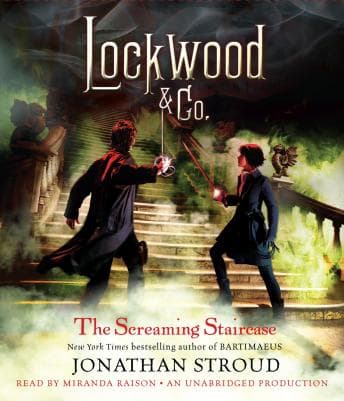

Jonathan Stroud built a world where ghosts are real, only kids can see them, and the adult response is basically to weaponize children with rapiers and iron filings. This understands that horror isn't about gore - it's about dread. And honestly? The fact that it's marketed as middle grade makes it hit harder, not softer.
I was shelving returns at the library on a Thursday evening, earbuds in, and Miranda Raison's Lucy Carlyle was walking me through the rules of ghost-hunting in an alternate London where the dead don't stay dead. Forty-five minutes in, I realized I'd been standing in the same aisle holding a copy of Dog Man and staring at nothing. That's the kind of book this is - it swallows you.
Stroud Remembers That Kids Deserve Real Scares
Here's what kills me about The Screaming Staircase: Stroud doesn't condescend. The Combe Carey Hall investigation - the centerpiece of the book, where Lockwood & Co. spend a night in one of England's most haunted houses - is genuinely, properly terrifying. The Red Room. The staircase itself, with its spectral screaming that builds and builds until you're white-knuckling your phone. And then there's the talking skull in the ghost jar, which shouldn't work as both comic relief and creeping unease, but somehow does. Stroud walks that line between funny-spooky and actually-spooky with the confidence of someone who's been doing this for years. Because he has. Shirley Jackson walked so this author could run - and I say that knowing full well this is a book for twelve-year-olds.
The worldbuilding is the secret weapon here. Ghost-touch kills. Iron and silver are defensive tools. Lavender keeps you safe. And the class dynamics between scrappy independent agencies like Lockwood & Co. and the massive corporate firms? That's not just flavor. That's structure. That's a world that feels lived-in from page one, and it gives every ghost encounter actual stakes. Though I'll say - nothing else in my recent listening has come close to matching that density of world-building investment, and I've been through a lot of audiobooks lately, including Last Trial, which builds its own procedural world with real care even if the ghosts are strictly metaphorical.
Lucy herself is the kind of narrator I'd follow anywhere - combative, sharp, a little wounded from whatever happened at her previous agency (Stroud knows exactly how much backstory to withhold). Her dynamic with Lockwood, who is all charm and recklessness and conspicuously absent personal history, crackles. And George, their research-obsessed third, grounds the whole thing with his sarcasm and his disgusting breakfast habits. These three kids running an unlicensed ghost-hunting agency out of a house on Portland Row? I'm in. I was in by chapter two.
Miranda Raison Gets It
The narrator commits. That's rare. Raison's Lucy is wry, brave, and distinctly Northern English - there's grit in her voice that separates her from the more polished tones she uses for Lockwood. Her George is nasally and slightly put-upon, which is exactly right. The comedic timing on the bickering scenes between the three of them lands perfectly, and when things go dark - really dark, like the night at Combe Carey Hall - she shifts into something urgent and breathless that had me walking faster through the library stacks without realizing it.
One legitimate gripe: some of the secondary male characters blur together vocally. The adult agents, the rivals, the authority figures - they occupy a similar register, and in a book with this many ghost-hunting professionals showing up, it can get muddy. It's not a dealbreaker. But if you're listening at speed or while distracted, you might lose track of which dismissive adult man is talking. (To be fair, the book kind of treats them as interchangeable too. Stroud is firmly on the side of his kid protagonists.)
Raison earned that AudioFile Earphones Award. Her pacing during the horror sequences - the way she'll rush through a sentence and then pause just long enough to let the dread settle - that's craft. That's someone who understands that audiobook narration is performance, not recitation.
Who Needs This in Their Ears
If you think horror for younger audiences means watered-down horror, this will correct you. If you loved Stroud's Bartimaeus books, you already know what he's capable of, and this is him working in a different key - less mythological bombast, more creeping dread and haunted staircases. If you scare easily, skip. If you don't, you need this. And if you're a grown adult who thinks you're too old for middle grade fiction, I'd gently suggest you're wrong, and this is the book that'll prove it.
My podcast listeners are going to love this. I'm already planning an episode on how Stroud uses ghost-lore as class commentary. Shirley (my cat) was unimpressed. I was terrified. And I've got four more books in this series to go.
Finally, horror that respects the genre - even when it's shelved in the children's section.