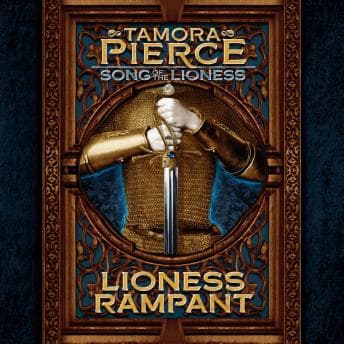

So I was up at 2 AM reorganizing my Kallax shelves - because apparently that's what my brain decides is urgent when my thesis chapter is due Thursday - and I needed something to listen to that wasn't another Brandon Sanderson reread. My buddy from the old D&D group had been bugging me for years about Tamora Pierce, calling her "the reason half the women in our hobby picked up a sword." Fair enough. I'd already burned through the first three Song of the Lioness books earlier this month (procrastination is a lifestyle, not a habit), and Lioness Rampant was sitting there in my queue like a final boss.
Seven hours later, my board games were alphabetized and Alanna of Trebond had saved Tortall. Productive night.
The OG Female Paladin Origin Story
Look, I need to be honest about something. This book was published in 1988. I wasn't even born yet. And reading it now - or listening to it, rather - you can feel that this is the template that a thousand YA fantasy heroines were built from. Alanna isn't just a knight, she's basically a level 15 Paladin on a fetch quest for an artifact of immense power (the Dominion Jewel), while her BBEG comes back from the literal dead to threaten the kingdom. If I pitched this at my D&D table, my group would eat it up.
But here's the thing that surprised me: for a book aimed at younger readers, Pierce doesn't pull punches. There's real consequence here. The political scheming around Tortall's succession feels like it matters. Alanna's relationships - romantic and otherwise - don't get wrapped up in neat little bows. And the Dominion Jewel quest takes her through the Roof of the World with a ragtag party that any tabletop player would recognize: the rogue love interest, the loyal companions, the mysterious guide. Pierce knew the formula before we called it a formula.
The magic system isn't Sanderson-level - it's softer, more intuitive, more "the Gift" as a general force than a hard rule set. But for what it is, it works. Alanna's purple fire and her connection to the Goddess feel earned by book four. You've watched her grow into this power across the whole quartet.
Trini Alvarado and the Curious Case of Faithful
Okay, the narration. Trini Alvarado is... fine? She's consistent across all four books, which counts for something. I got that same consistent tone from her in In the Hand of the Goddess, and it helped the series feel cohesive. Her Alanna has this determined, slightly stubborn quality that fits the character. And there are moments where she genuinely makes you feel like you're riding alongside Alanna - one listener apparently relistened all four books fifteen times, which is commitment I respect.
But - and Steven Pacey fans, you'll feel this - the character differentiation is thin. George Cooper, Jonathan, Raoul - they blur together more than they should. The men especially tend to sound like variations of the same voice with slightly different energy levels. For a book where the political dynamics between these characters drive half the tension, that's a problem.
And then there's Faithful the cat. Voiced as female. Faithful is male. I know this is a small thing but once you notice it, every single Faithful line pulls you out of the moment. It's like if someone cast your familiar wrong in a campaign - technically it still works but it bugs you every single time.
The production itself is clean but bare bones. No music, no effects, just straight narration. At seven hours it never overstays its welcome, but I wouldn't say Alvarado brings the kind of polish that elevates a good book into a great audiobook experience. Some of the bigger emotional moments land a little flat when they should hit like a critical hit.
Who This Quest Is Actually For
If you grew up on Tamora Pierce, this audiobook is a nostalgia trip worth taking - just maybe through your library app rather than a full credit. If you're a parent looking to introduce your kid to fantasy with a strong female protagonist who predates Katniss by two decades, this whole quartet is gold.
But if you're coming in cold as an adult fantasy listener used to 40-hour epics with intricate magic systems and top-tier narration? Calibrate your expectations. I found that intricate depth in Empire of Gold, where the magic system made me take notes like I was prepping for a campaign. This is YA from the late '80s. It's foundational, not complex. The pacing moves fast - almost too fast in places, cramming political upheaval and quest completion and romance resolution into seven hours. Things that could breathe don't always get the space.
I read this instead of writing my thesis and I don't regret it. But I also don't think I'll relisten fifteen times.
Roll for Nostalgia, Modifier Optional
Tamora Pierce built something that mattered with these books. Alanna's journey from disguised page to legendary knight errant is the kind of story that shaped an entire generation of fantasy readers - and writers. The audiobook format with Alvarado is a perfectly serviceable way to experience it, especially if your hands are busy and your eyes are tired. But "serviceable" is the ceiling here, not the floor. The story deserves a narrator who'd give it the full Pacey treatment - distinct voices, emotional peaks, the works. What we get instead is reliable but rarely electric.
Still. Seven hours. A quest for a legendary artifact. A villain rising from death. A heroine who earned her legend the hard way. My D&D group would love this. I just wish the audio made me feel it as much as I know I should.