
What happens when the books you assign your students actually hold up better than the ones you read in grad school?
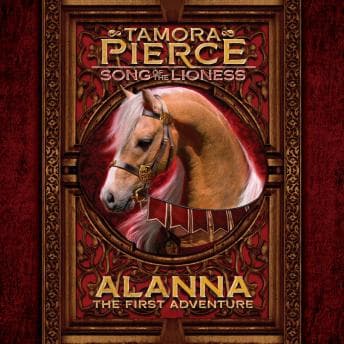
I've been teaching *The Odyssey* for two decades, watching sixteen-year-olds roll their eyes at the hero's journey. But here I am, grading papers at 11 PM with Tamora Pierce in my earbuds, and I'm the one having the revelation. Alanna of Trebond isn't just a girl pretending to be a boy to become a knight—she's doing what Odysseus did, minus the decade of dithering around with sea nymphs. And she's doing it in five hours.
The Book I Wish I'd Had at Fifteen
Let me be honest about something. When I first saw this in my queue—young adult fantasy, published in 1984, barely five hours—I thought it would be a palate cleanser between Middlemarch episodes. Something light. Background noise for faculty meeting season.
I was wrong.
Pierce writes with the economy of Hemingway, if Hemingway had been interested in teenage girls learning swordcraft instead of bullfighting. Call of the Wild has that same stripped-down efficiency—London never wastes a word on Buck's transformation. Every scene serves purpose. There's no fat here, no meandering subplots about trade negotiations or elaborate magical systems requiring appendices. Alanna needs to protect Prince Jonathan from a sorcerer. Alanna needs to pass the Ordeal to become a knight. Alanna needs to figure out who she is when she stops pretending to be someone else.
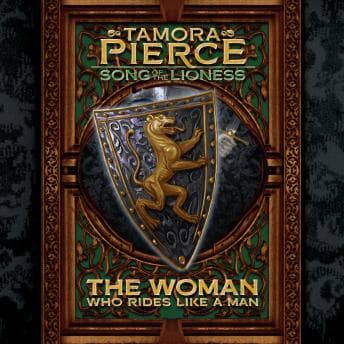
The moment her shield transforms—when the crest changes to a golden Lioness after she reveals her identity—that's the kind of symbolism I'd spend a whole class period unpacking. Pierce doesn't belabor it. She trusts her readers. My students would actually love this. (I'm not sure how I feel about that.)
Trini Alvarado Understands the Assignment
Here's what separates adequate narration from interpretation: Alvarado doesn't just read Alanna's internal conflict—she performs it. When Alanna is playing the boy squire, there's a careful tension in the voice, a slight lowering of register that never quite feels comfortable. When she's alone, when she can be herself, the voice relaxes into something warmer.
The male characters get distinction too. Jonathan sounds like privilege wrapped in genuine kindness. The antagonist—and I won't spoil who—carries this silky menace that made me look up from a stack of sophomore essays more than once. Alvarado gives immortals a different weight than humans, a slight otherworldliness in the cadence.
At 1.0x speed (because the author chose those words, and I choose to hear them properly), the pacing feels deliberate. This isn't a book that rushes toward its climax. It earns it.
What Pierce Taught Me About Teaching
I spend a lot of time telling students that great literature makes you see yourself differently. That the classics endure because they capture something true about being human. And then I hand them *Lord of the Flies* and watch their souls leave their bodies.
Pierce does something I rarely see in the books we canonize: she writes a young woman who is allowed to be angry, ambitious, scared, and powerful without being punished for any of it. Alanna makes mistakes. She doubts herself. She also wins. Not because she's the Chosen One (though there are prophecy elements), but because she works harder than everyone around her and refuses to quit.
This is why we still read the classics—or why we should. Not because they're old, but because they show us what's possible. Pierce earned that Margaret A. Edwards Award.
Who This Is For (And Who Should Skip)
If you need grimdark complexity, elaborate magic systems, or protagonists who spend three books learning to believe in themselves, this isn't your book. Pierce doesn't have time for that. Alanna believes in herself from page one—her problem is getting everyone else to see what she already knows.
But if you're the kind of person who loved fantasy as a teenager and forgot why? If you want something you could share with a kid in your life without feeling like you're assigning homework? If you just need five hours of a young woman being competent and brave and occasionally making out with princes? This is the spiritual successor to every adventure story you loved before someone told you fantasy was childish.
Class Dismissed
I finished this during Principal Martinez's quarterly budget presentation. (Sorry, Principal Martinez. I was definitely not listening to your enrollment projections.) And when the Ordeal ended, when Alanna received her shield from her twin brother Thom, I had to pretend I was emotional about facilities maintenance funding.
Five hours. That's all it takes to remember why you fell in love with stories in the first place.
My students would hate that I'm recommending a book from 1984. They'd probably love the book itself. At five hours, you can savor it twice.