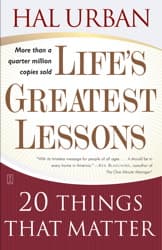

Jenny and I were cleaning out the garage last Saturday - one of those forced-march decluttering sessions she schedules quarterly - and I needed something light to keep me from arguing about whether we really need to keep my old McKinsey onboarding binders. (We do. She disagrees.) So I put on Hal Urban's Life's Greatest Lessons and figured I'd knock it out before we got to the holiday decorations box.
I finished it before we even reached the back wall. Two hours and thirty minutes. That's it.
Bottom line: This is a good book that knows what it is. It's not trying to be a 12-hour manifesto on reinventing your life. It's twenty short chapters, each delivering one principle about living well - honesty, gratitude, attitude, the real meaning of success - and then getting out of your way. I respect that enormously, even if the content itself won't blow any experienced reader's mind.
The Book My Parents Never Needed to Read
Here's what got me. Chapter after chapter, I kept thinking: this is what my parents did instinctively. Now it has a TED talk. Urban writes about the value of hard work, about how character matters more than reputation, about choosing your attitude every morning. My mom and dad didn't learn this from a doctorate in education - they learned it running a dry cleaning shop on Western Ave for twenty-three years. But here's where Urban earns his keep: he's a high school teacher who spent decades watching kids absorb (or fail to absorb) these principles. He writes from the classroom, not the boardroom, and there's a groundedness to his perspective that most self-help authors can't fake.
The chapter on success versus significance hit differently than I expected. Urban draws a clean line between achievement and meaning - not a new idea, but he delivers it with a teacher's patience rather than a guru's smugness. And his section on the power of words, specifically how the language we choose shapes our reality, is actually backed by examples from his classroom experience rather than the usual cherry-picked studies. He talks about watching students physically change posture when they shifted their vocabulary. That's not theory. That's thirty years of observation.
Author-Narrated and It Actually Works
Urban narrates his own book, which - look, I've suffered through enough author-narrated audiobooks to be skeptical. Most authors should stay on the page. But Urban is a teacher. A career teacher. His delivery has that clear, unhurried quality of someone who's spent decades making sure the kid in the back row understands. No dramatic vocal shifts, no performance tricks. Just a man talking to you like you're a person who deserves straight answers.
At 2.0x speed, this book is basically a one-hour conversation with a smart, kind person. I actually bumped it down to 1.5x at one point because I realized I was processing faster than I was absorbing, which almost never happens. The sections are short and digestible - each lesson runs maybe seven to ten minutes - so you can easily revisit the ones that land without scrubbing through hours of filler.
The production is clean. No sound effects, no music, no nonsense. Just voice and content.
Where It Falls Short (And Where That's Fine)
I'm going to be honest: if you've read more than ten self-help or business books, maybe 60% of this content will feel familiar. "Be grateful." "Choose positive attitudes." "Words have power." I've seen these ideas repackaged in books three times this length with half the clarity. Urban doesn't pretend he invented these concepts - he's explicitly synthesizing wisdom, not claiming originality.
But that's also the limitation. There's no proprietary framework here, no model you can take into a Monday morning meeting. It's not that kind of book. Jenny would say I'm being harsh. Jenny is right. Not everything needs to produce quarterly results. Some books are mirrors, not maps. This one holds up a mirror and asks if you're actually living the way you already know you should. Girl, Wash Your Face operates in the same mirror-holding territory, though Rachel Hollis is considerably louder about it and the reflection she offers is a lot more Instagram-filtered than Urban's.
For a quarter-million copies sold, it makes sense. This is the book you give your twenty-two-year-old nephew at graduation. It's the audiobook you replay every January when you're recalibrating. It's not going to change the game for a forty-year-old consultant with 400 titles in his Audible library, but it reminded me of a few things I'd conveniently optimized out of my daily routine.
Who Gets the Most ROI
If you're early in your career, early in adulthood, or just feeling like you've been grinding without purpose - this is a solid reset. People who grew up without parents modeling these principles will find real value here. If you're a parent yourself, it's worth the listen just to sharpen how you talk to your kids about what matters.
Skip it if you need tactical frameworks, business models, or anything with an implementation checklist. This isn't that. It's philosophy dressed in common sense, delivered by someone who's earned the right to teach it.
Finally, a business book - well, life book - that respects your time. Two and a half hours. Twenty lessons. No padding. My parents would approve of the efficiency, even if they'd already known the content by heart.