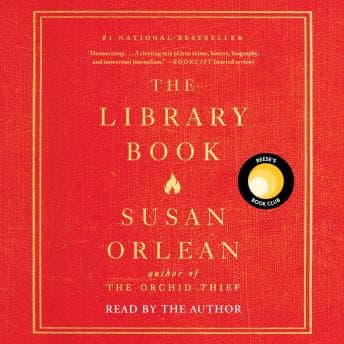

What happens when you mix an unsolved arson case with a love letter to one of America's most overlooked institutions? You get Susan Orlean spending twelve hours in your ear, and honestly? I wasn't sure I was ready for it.
Look, I'll cut to the chase: I went into this expecting a true crime investigation about the 1986 Los Angeles Public Library fire. 400,000 books destroyed, 700,000 damaged, temperatures hitting 2000 degrees - that's the kind of catastrophic detail that grabs a guy like me. I've seen what fire does to structures, to communities. This should've been right in my wheelhouse.
But here's the thing - Orlean delivers something stranger and, I'll admit, more interesting than a straight investigation.
When the Investigation Becomes Something Else
The fire and the suspected arsonist, Harry Peak, weave through this book like reconnaissance threads. You get bits and pieces, then Orlean pulls you into the history of the LAPL, then she's talking about her mother taking her to the library as a kid, then suddenly you're learning about an 18-year-old woman named Mary Foy who ran the whole operation in 1880. It's not linear. It's not how I'd run a debrief.
And yet - it works. Ranger and I logged a lot of highway miles with this one, driving between client sites in Hill Country, and the structure kept me alert. Just when I'd think "okay, get back to the fire," she'd introduce some character like Charles Lummis, this eccentric journalist who basically willed the LA library into greatness, and I'd be hooked again.
The historical research here is solid. Orlean clearly did her homework, and as someone who can't stand sloppy intel, I appreciated that. That same thoroughness in tracking how institutions shape civilization reminded me of Story of Mankind, though Orlean's focus is narrower and more personal. She traces libraries from charitable initiatives to cultural cornerstones, and she does it without getting preachy about it. That's harder than it sounds.
The Author in Your Ear
So here's where I need to be straight with you. Susan Orlean narrates her own book, and your mileage will vary. Her voice is Midwestern, a bit flat, a little nasal. Not the polished performance you'd get from a professional narrator. Some folks find it authentic - she wrote it, she knows the rhythms. Others will reach for that speed button.
I bumped it to 1.25x about two hours in. Not because she was bad, but because her pacing runs slow. There's a difference. At normal speed, she occasionally sounds like she's reading to herself rather than to you. Speed it up slightly and the material flows better. Her dry humor comes through more clearly too - there's wit buried in there that gets lost at the slower pace.
Fair warning: her pronunciation of foreign words isn't great. If that kind of thing bothers you, you'll notice it. Didn't ruin it for me, but I've heard complaints.
The Real Mission Here
What surprised me most was how much this book made me think about libraries differently. I'm not a sentimental guy about institutions - I've watched too many of them fail their people. But Orlean makes a case for public libraries that's hard to argue with. She shows you the homeless population using them as day shelters. The immigrants learning English. The kids with nowhere else to go after school.
There's a section where she just... hangs out in different departments of the LAPL, talking to staff, watching what actually happens in a modern library. It's on-the-ground reporting, the kind I respect. No agenda, just observation. The librarians she profiles are doing work that matters, even if nobody's pinning medals on them.
Did she solve the arson case? I won't spoil it, but I'll say this: the investigation is almost beside the point by the end. Orlean's real subject is why it matters that someone might have tried to destroy this place. What was actually lost in those flames.
SITREP: Worth Your Time?
If you're looking for a tight true crime procedural, this isn't it. The structure meanders. The narration requires adjustment. Skip this one if you need a linear investigation with a clean resolution - you'll be frustrated by hour three.
But if you can handle a book that's more meditation than investigation, there's real value here. Orlean's research is thorough, her characters are memorable, and she makes you care about an institution you probably take for granted. I finished it thinking about my own library growing up, which is not something I expected from a book about arson. This one's for readers who appreciate slow-burn nonfiction that wanders with purpose.
Ranger approved this one, though he fell asleep during the chapter about library classification systems. Can't blame him there.
Bottom line: Sample the first chapter before you commit. If Orlean's voice works for you, you're in for a surprisingly engaging ride. If it grates, grab the print version instead - the writing deserves to be experienced one way or another.






![Steve Jobs [unabridged audiobook] audiobook cover](/_next/image?url=https%3A%2F%2Fcovers.audiobooks.com%2Fimages%2Fcovers%2Ffull%2F9788499923406.jpg&w=1920&q=75)