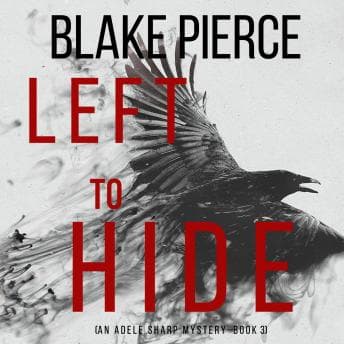

I muttered something about attachment trauma to absolutely no one around hour seven, standing in my kitchen at 11 PM, burning garlic because I was too absorbed in Adele Sharp's psychological spiral to pay attention to the pan. The protagonist exhibits classic anxious attachment patterns—daddy issues, unresolved maternal grief, compulsive need to prove herself internationally. As a character study, she's genuinely interesting. As someone to spend eight and a half hours with? Let's just say my therapist would have thoughts.
When Your Case Study Won't Stop Ruminating
Here's what makes Adele Sharp compelling: she's a mess in ways that actually track psychologically. FBI agent with French-American dual citizenship, fluent in multiple languages, stationed in Paris—sounds glamorous until you realize she's using international crime-solving as avoidance behavior. Classic displacement. Her mother's unsolved murder haunts every decision, and now she's forced to work alongside her estranged father in Germany? Fascinating case study in how unprocessed trauma manifests in professional contexts.
But—and this is where I started stress-eating burnt garlic bread—the last hour is almost clinical in its repetition of Adele's self-doubt. "Should I trust him? Can I trust him? What if I can't trust him?" I kept asking myself: why does the author need to externalize every internal hesitation? Wife Between Us: A Novel handles unreliable narrator anxiety much better—the paranoia feels earned rather than performed. We get it. She's conflicted. The human mind doesn't actually loop this transparently; it's messier, more contradictory. This reads more like the author ensuring we don't miss the emotional stakes than realistic internal monologue.
Abigail Reno's German Vacation
The narration is... fine. Competent. Reno handles the suspenseful scenes with genuine tension—there's a chase sequence in the middle third where her pacing had me gripping my wooden spoon like a weapon. But the European accents. Oh, the European accents. They're not offensive, exactly, just distractingly theatrical. German characters sound like they're auditioning for a community theater production of Cabaret. The Italian victims' dialogue early on has this exaggerated Mediterranean lilt that pulled me right out of the crime scene.
And look, I get it—international thriller, international accents, makes sense in theory. But when you're mispronouncing basic German words (listeners have noticed, I'm not alone here), the accent commitment feels misplaced. Prioritize accuracy over flavor, maybe?
The Father-Daughter Dynamic (Where It Actually Works)
What the author understands about human nature: complicated parental relationships don't resolve neatly. Adele's father knows something about her mother's death. He's clearly hiding information. That same push-pull of family secrets and loyalty shows up in Family Upstairs: A Novel, though with even messier generational trauma. And yet—this is the part that kept me listening past my usual bedtime—there's genuine affection underneath the dysfunction. They're not just plot devices for each other. The tension between wanting to trust him and knowing he's withholding feels earned.
This is where Blake Pierce's formula actually serves the story. Yes, it's book three in a series. Yes, there are clearly threads being saved for future installments. But the central mystery—Italian tourists murdered in Germany, international jurisdictional chaos, Adele navigating both the case and her family trauma—provides enough standalone satisfaction that I didn't feel cheated by the ongoing subplots.
Who Should Investigate (And Who Should Sit This One Out)
If you're a completionist who started the Adele Sharp series, this delivers exactly what you expect. Enjoy procedurals with a side of family drama and can tolerate some repetitive internal monologue? You'll find enough here to justify the eight-plus hours. The international settings provide nice variety—Germany feels distinct from the Paris-based earlier books.
Skip it if narrator accent work is a dealbreaker, or if you need your protagonists to have their psychological breakdowns efficiently. The "excruciating" last hour that other listeners mention? They're not wrong. It's emotionally taxing in a way that feels more like padding than payoff.
Case Closed (Dinner Ruined)
I finished this at 1 AM, having successfully ruined dinner but successfully solved the case alongside Adele (I called the twist around hour five—the behavioral patterns were too consistent not to). It's not a masterclass in psychological realism, but it's competent thriller comfort food with a protagonist whose issues are at least rooted in recognizable trauma responses. The father subplot adds genuine emotional weight that elevates it above pure procedural.
Worth a credit? Probably not at full price. But if you've got a long cooking project planned and don't mind yelling at a fictional FBI agent to just make a decision already, it'll do the job.