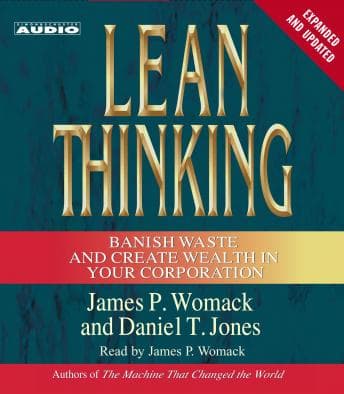

Look, I have a problem with business books that could've been a memo. You know the type - one good idea stretched across 300 pages like too little butter over too much bread. So when I tell you Lean Thinking actually earns its runtime? That's saying something.
But let me get my complaint out of the way first: Womack and Jones narrating their own book is... a choice. These guys are brilliant consultants. They are not professional narrators. The delivery is about as warm as a McKinsey slide deck. Functional. Clear. Gets the job done. But engaging? Meh. I've sat through more dynamic quarterly reviews.
What My Parents Knew Before Toyota Made It Famous
Here's what got me about this book - and I mean genuinely got me. The core lean principles? Eliminate waste. Create flow. Pull don't push. Continuous improvement. My parents ran a dry cleaning shop in Koreatown for 30 years. No MBA. No consulting framework. But they did all of this instinctively. Dad would rearrange the equipment every few months trying to shave minutes off the process. Mom tracked every customer complaint in a spiral notebook and actually fixed things. They just called it "not being stupid with money." That kind of quiet, unglamorous wealth-building is exactly what Millionaire Next Door celebrates—people who get rich by not being stupid with money.
Now it has case studies from Porsche and Pratt & Whitney. Now it's a management philosophy. I'm not being cynical here - I actually appreciate that Womack and Jones codified what works. The Lantech and Wiremold examples are particularly solid because they're mid-sized companies, not just Toyota worship. Real businesses making real changes with measurable results.
The 2.0x Speed Test
At just under 5 hours, this is already lean by business book standards. (See what I did there?) I listened at my usual 2.0x and didn't miss anything. The authors get to the point - no padding, no motivational fluff, no "imagine a world where" nonsense. Finally, a business book that respects your time.
The structure works too. Part I gives you the concepts with real examples. Part II is the action plan. Part III extends it to the full value chain. Part IV updates everything post-2000s. It's logical. It's practical. It's exactly what you'd expect from guys who've spent their careers eliminating waste - including wasted pages.
Now, the caveat: this is manufacturing-heavy. The examples lean (sorry, can't help it) toward production environments. If you're running a SaaS startup or a consulting practice, you'll need to translate. The principles apply - I've used lean thinking with clients across industries - but the book won't do that translation work for you.
Who Gets ROI Here (And Who Doesn't)
If you're in operations, supply chain, or manufacturing leadership, this is required reading. Period. The framework has stood up for decades while flashier management fads have crashed and burned. I've seen this work at three different companies I've consulted for. The ones who actually implemented it - not just talked about it in leadership offsites - saw real results.
But here's the thing. The narration makes this a tough first introduction to lean. If you're brand new to these concepts, you might want to read the physical book first or find a more engaging primer. Coming in cold to Womack's monotone explanation of value streams could put you off the whole philosophy. And that would be a shame because the content is genuinely useful. Skip this if you need charisma to stay awake - or if you're looking for service-industry examples out of the box.
For the rest of us - the folks who've heard the buzzwords, maybe dabbled in lean, but never really systematized it - this is solid. I listened during a cross-country flight and actually took notes. That's rare for me. Jenny would say I'm being generous because I'm biased toward anything that validates my efficiency obsession. Jenny is right. But the book still delivers.
Stop Reading, Start Implementing
Skip to chapter 5 if you want the action plan without the theoretical setup. Thank me later. Or don't - just implement something and stop reading about implementing things. That's pretty much the whole point of the book anyway.