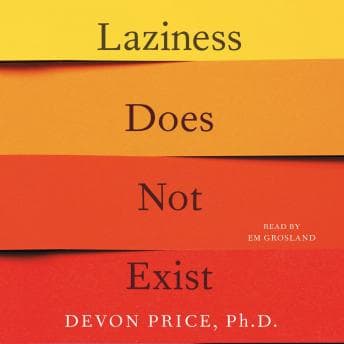

How many times have you dragged yourself onto a 6AM train, half-dead, coffee barely working, and thought "I should be more productive with this time"? Because I have. Literally every morning. And then Devon Price's book told me that impulse is basically a psych virus inherited from the Puritans, and honestly? I felt personally attacked in the best possible way.
The Self-Help Book That Told Me to Stop Listening to Self-Help Books
TL;DR: Worth your commute, with caveats.
So here's the premise: the belief that laziness is a moral failing is a lie. Price — a social psychologist at Loyola University Chicago — traces this "laziness lie" back to Puritan work ethic, through the industrial revolution, straight into our Slack-pinged, always-on, side-hustle-glorifying present. The core argument is that when someone appears "lazy," there's almost always an underlying reason — exhaustion, trauma, lack of resources, undiagnosed health issues. Price knows this firsthand: they pushed so hard through college and grad school (graduating early from both) that they ended up with severe anemia and heart complications.
This is basically Burnout by the Nagoski sisters but for the systems-level "why" instead of the biological stress cycle. Price pulls from their own research and interviews with real people — overworked consultants, students drowning in extracurriculars, people who literally cannot stop saying yes to things. The class and resource dimension of that argument gets even more granular in Unequal Childhoods, which I kept thinking about alongside this one — Lareau's data on how families with different resources teach kids to relate to institutions and authority lands differently once you've absorbed Price's framing. The Puritan origins stuff is genuinely interesting and not something I'd seen laid out this clearly before. The chapter on how digital tools have obliterated work-life boundaries hit different when I read it on my work laptop at 11PM. (Yes, I see the irony.)
But here's where my engineering brain gets itchy: the book could've been tighter. At 7 hours 51 minutes, there's significant repetition. Price makes the core argument convincingly in the first third, and then... keeps making it. With more examples. And more interviews. It's the classic self-help problem — a genuinely good thesis padded to book length. Could've been a blog post? No, that's too harsh. Could've been a 4-hour audiobook? Absolutely. I bumped this to 1.75x by hour 5 and didn't miss a thing.
The practical advice sections — setting boundaries, identifying your own laziness-lie triggers, learning to say no — are solid but not groundbreaking if you've already read in this space. If this is your first "maybe I'm not broken, maybe the system is" book, the ROI is high. If you've already been through Burnout, Four Thousand Weeks, and How to Do Nothing, you're going to spend a lot of time nodding along without learning much new.
Em Grosland: The Narrator Discourse
Okay, this is where things get divisive. Em Grosland's narration is... enthusiastic. Very enthusiastic. The conversational tone actually works well for the material — this isn't a dense academic text, it's meant to feel like a smart friend explaining something over coffee. And Grosland does that.
But I get why some people bounced. There's an earnestness to the delivery that can tip into what I'd describe as — and I'm trying to be precise here — a slight pleading quality? Like Grosland really, really wants you to believe this, and that intensity doesn't let up. At 6AM surrounded by other dead-eyed commuters, there were moments where the energy level felt mismatched with my reality. Some listeners have called it "whiny," which I think is unfair but I understand where it comes from. It's more that there's no dynamic range — the emotional register stays at about a 7 out of 10 for the entire runtime. No quiet moments. No pulling back. Just sustained earnest conviction.
I didn't hate it, but I also didn't love it. It's functional narration for a book whose ideas are the main attraction.
Who Gets the Most Mileage Here
Perfect for: train, gym. Skip for: deep work (you'll zone out during the repetitive middle sections).
If you're a chronic overachiever who intellectually knows they need to slow down but can't stop optimizing — hi, I'm in this photo and I don't like it — this book is a good permission slip. It won't fix you. But it'll name the thing. And sometimes naming the thing is step one.
If you're already well-read in the anti-hustle-culture space, or if narrator energy levels are a dealbreaker for you, stream it from Libby first before committing a credit.
The Commit Message
I finished this in about 4 commutes at 1.75x. It's a solid 3.5-star book — good thesis, decent research, real interviews that ground the theory in actual human experience. But it needed an editor willing to cut 30%, and the narration is going to be polarizing. I'm glad I listened. I'm also glad it's done. And I'm going to try — try — to not check my work email before 8AM tomorrow. We'll see how long that lasts.