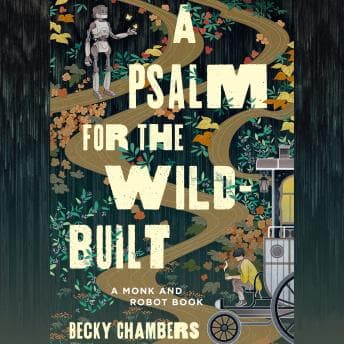

Look, I need to rant about something first. I've been putting off my thesis for three weeks now - Dr. Patel sent me another "checking in" email that I'm definitely going to respond to tomorrow - and instead of doing literally anything productive, I've been listening to a four-hour audiobook about a monk who serves tea and a robot who asks philosophical questions. And you know what? I regret nothing.
Becky Chambers wrote a book that's basically the literary equivalent of a warm blanket and a cup of chamomile, and I consumed it in one sitting while reorganizing my board game shelf (a task I've been avoiding almost as long as my thesis). The thing is, A Psalm for the Wild-Built shouldn't work as well as it does. There's no epic battle. No chosen one prophecy. No magic system to diagram - and you know how much I love diagramming magic systems. It's just Sibling Dex, a tea monk going through what we'd call a quarter-life crisis, meeting Mosscap, a robot who wandered out of the wilderness after centuries of self-imposed exile.
When Your D&D Campaign Goes Full Philosophy
Here's where I started discovering why this book hit different than I expected. The world-building is sneaky. Chambers doesn't info-dump (and you know I'm usually pro-info-dump), but Panga feels lived-in. This is a post-scarcity society that actually figured things out - factories became forests, robots gained sentience and just... left to go find themselves. The humans rebuilt around sustainability and found meaning in small crafts like tea service. It's the kind of setting my D&D group would spend six sessions debating the economic implications of before anyone rolled initiative.
But the real hook is the central question Mosscap keeps asking: "What do people need?" And Dex can't answer it. Neither can anyone they meet. It's the kind of heavy-duty pondering that could feel preachy, but Chambers keeps it grounded in these small, specific moments - Dex brewing different teas for different emotional needs, Mosscap cataloging cricket species with genuine wonder.
Em Grosland's Voice Work (The Complicated Part)
Okay, so here's where things get interesting. Em Grosland does something really effective with the two leads - there's this subtle shift between Dex's restless, searching energy and Mosscap's gentle curiosity. The robot doesn't sound robotic in a cliché way; there's warmth there, but also this slight formality that reminds you Mosscap is experiencing human interaction for the first time.
But - and I noticed this around hour two - there are some jarring moments where you can hear the edit seams. Pitch changes mid-sentence that suggest different recording sessions got spliced together. It pulled me out of the story a few times, which is frustrating because when Grosland is locked in, they really capture what AudioFile called "the essence of a troubled soul in search of peace." That's not hyperbole. During Dex's quieter moments of doubt, the narration carries genuine emotional weight.
Some listeners apparently found it flat or inconsistent, and I can see where they're coming from. But for me, the performance worked more often than it didn't. Just... be prepared for a few technical hiccups.
This Is Not Your Background Listening Book
I tried listening while cooking dinner and completely lost the thread. This is a book that rewards your full attention - not because the plot is complex (it's not), but because the philosophy sneaks up on you. One minute you're hearing about monastery architecture, the next you're having a minor existential crisis about whether your own life has meaning. The Midnight Library pulled the same trick on me—gentle premise, sudden gut-punch about life choices. (Thanks, Becky. Really needed that while my thesis sits unfinished.)
At just over four hours, it's the perfect length. Long enough to build the relationship between Dex and Mosscap, short enough that the gentle pacing never drags. If you're coming from Sanderson or other epic fantasy, this will feel like a palette cleanser. A really good one.
Who Should (and Shouldn't) Wander Into These Woods
If you need action, conflict, or a magic system with rules you can exploit - skip this. Same goes for Confessor—different vibe entirely, more traditional fantasy structure. If you're in the mood for something that asks big questions without demanding big answers, something that feels like a deep breath after too much doom-scrolling, this is your book. My D&D group's resident philosopher would love this. Our min-maxer would throw it across the room.
The swearing caught me off guard given the cozy vibes - nothing excessive, but worth noting if you're expecting pure wholesome.
Roll for Emotional Damage
I finished this at 2 AM, board games finally organized, thesis still untouched, feeling weirdly peaceful about all of it. That's the Becky Chambers effect. She writes hope like it's a reasonable thing to have. In a world where robots chose freedom and humans chose sustainability and everyone's still figuring out what they actually need - yeah. That hit.
Now if you'll excuse me, I have an email to ignore and a sequel to start.