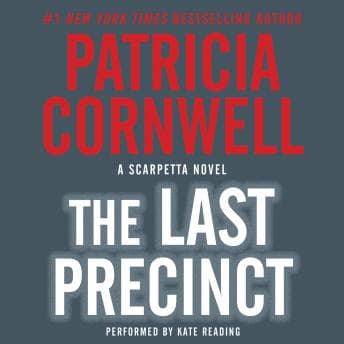

I was shelving returns in the back room of the library last Thursday — the part of the building where the fluorescent lights flicker in a way that our maintenance guy swears is "just the ballast" but which I choose to interpret as atmospheric — when I started this one. Seventeen hours is a commitment, and I'd been circling The Last Precinct for a while because I have a complicated relationship with Patricia Cornwell. She writes forensic procedure like she's lived it (she basically has), but by book eleven in any series, you're either still in love or you're hate-listening. I needed to know which one this would be.
Here's where I landed: somewhere in between, and that's more interesting than either extreme.
Scarpetta Without Her Armor
The thing that got under my skin about this book — and I mean that as both compliment and complaint — is that Cornwell strips Kay Scarpetta of everything that makes her formidable. Her home is a crime scene. She's under grand jury investigation. The man who attacked her, Chandonne, is in custody but his shadow is everywhere. And then Cornwell makes the bold choice to pull us out of Scarpetta's head. Previous books in the series used first person, letting you sit inside Kay's clinical, controlled perspective. The Last Precinct shifts to third person, and it's disorienting in a way that actually works thematically — you're watching Scarpetta from the outside at the exact moment she's most vulnerable, most paranoid, most unable to trust her own read on the people around her. That distance? It mirrors her isolation.
But I get why some listeners bounced off it. If you've spent ten books inside this woman's skull, suddenly being locked out feels wrong. Like visiting a friend's house and they won't let you past the foyer.
The paranoia engine here is real, though. Cornwell builds this slow-tightening web where Scarpetta's allies keep turning into question marks — Anna Zenner, her supposed safe harbor, getting subpoenaed; the forensic evidence pointing away from the obvious suspect; the creeping realization that someone's been engineering her downfall for years. This understands that horror isn't about gore — it's about dread. And yes, I'm calling this horror-adjacent. That slow-building dread over spectacle is something I've been thinking about a lot lately — Autopsy leans harder into the procedural machinery but still knows the real chill comes from what you can't quite name. The Chandonne attack aftermath, the psychological bruising, the way Cornwell writes trauma responses with the clinical detachment of someone who's actually read autopsy reports — it sits in that uncomfortable space between thriller and something darker.
Kate Reading Carries the Weight
Kate Reading is an AudioFile Golden Voice for a reason, and she earns it here. With a cast this sprawling — Scarpetta, Marino, Benton (or the ghost of Benton, depending on where you are in series lore), Jaime Berger, Anna Zenner, and a small army of law enforcement and legal professionals — the vocal differentiation could've collapsed into a mess. It doesn't. Reading gives Scarpetta this tightly controlled register that cracks at specific moments, and you feel those cracks because she's been holding the composure so steadily. Berger gets a cooler, more clipped delivery that reads as New York prosecutor without being cartoonish. Marino stays Marino — gruff, blunt, the vocal equivalent of a rumpled suit.
The narrator commits. That's rare.
Where Reading really shines is in the forensic passages. Cornwell writes procedure-heavy sequences that could absolutely flatline in audio — detailed pathology, evidence chain discussions, the bureaucratic machinery of a grand jury — and Reading paces them with enough weight that they feel like revelation rather than lecture. She knows when to slow down and when to let the clinical language do the work.
The Slow Burn That Tests Your Patience
Here's my honest frustration: at nearly seventeen hours, this book feels its length. The paranoia is effective, but Cornwell layers gloom on top of doubt on top of more gloom, and by hour ten I was shelving books with the kind of aggressive precision that made my coworker ask if I was okay. The pacing is deliberate — I'll be generous — but there are stretches in the middle where the plot treads water while Scarpetta spirals. If you're coming from faster Scarpetta entries, this will test you.
I'd almost recommend 1.25x speed for the middle third, then dropping back to normal when the forensic trail starts clicking into place in the final act. That last quarter is where Cornwell remembers she's writing a thriller and not just a character study in sustained misery.
(Shirley — my cat — fell asleep on my chest during one of the slower stretches. She was unimpressed. I was somewhere between frustrated and fascinated, which I think is exactly where Cornwell wanted me.)
Who Needs This in Their Ears
If you've been following the Scarpetta series and you're invested in the long game Cornwell is playing — the Chandonne arc, the institutional betrayals, the slow erosion of Kay's world — this is essential. It's a pivot point. If you're new to the series, absolutely do not start here. You'll be lost in about twelve minutes.
If you want fast-paced forensic thrills, this isn't it. If you want a claustrophobic psychological descent where the smartest person in the room can't figure out who's destroying her life, and you want it delivered by a narrator who understands that restraint is its own kind of intensity — yeah. This is your book.
If you scare easily, skip. If you don't, you need this — but for the paranoia, not the body count.
The Catalog Card
I'm filing this one under "difficult but worthwhile." Cornwell takes real risks with the narrative shift and the relentless bleakness, and not all of them pay off equally. But Kate Reading's performance elevates the material past its pacing problems, and the central mystery — who's been building this trap, and why — kept me turning pages (or, well, kept me not hitting pause) even when the gloom threatened to swallow the story whole. My podcast listeners are going to love arguing about whether the third-person switch was genius or a mistake. I'm still not sure myself, and that's the kind of uncertainty that makes for good horror-adjacent fiction.