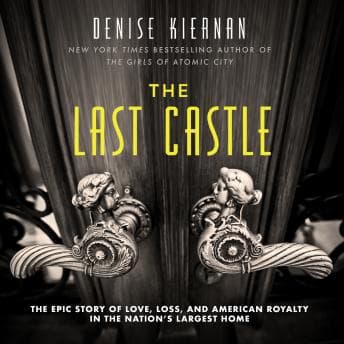

Jenny and I took the kids to Biltmore two Christmases ago. You know the trip - the one where you pay $75 a head to walk through a house that makes you feel simultaneously awed and slightly nauseous about wealth inequality. I remember standing in the banquet hall thinking: someone built this. On purpose. With intent. And then what? That question stuck with me, which is probably why I grabbed Denise Kiernan's audiobook when it popped up in my recommendations last week.
I started it on a red-eye back from a client engagement in Charlotte - fitting, since Biltmore sits just a few hours west in Asheville. By the time we landed at LAX, I was five hours deep and genuinely annoyed that the plane had wifi issues because I wanted to look up floor plans.
A 175,000-Square-Foot Case Study in Capital Misallocation
Here's what got me. George Vanderbilt wasn't the robber baron you'd expect. He was the bookish, quiet one - the youngest of the Vanderbilt siblings, more interested in collecting rare editions and studying architecture than running railroads. The guy spoke eight languages. He poured something like $300 million in today's dollars into building a 250-room chateau on 125,000 acres of North Carolina mountains. He hired Frederick Law Olmsted - the Central Park guy - to handle the landscape and Richard Morris Hunt to design the house itself.
From a pure business standpoint, this is insanity. My parents would have looked at those numbers and had a collective stroke. You're telling me a man built a house three times the size of Washington, DC, filled it with Renoirs and Sargents and a 10,000-volume library, and then... had no real revenue model? No sustainable income plan for maintaining it? That's not a home, that's a burn rate.
But Kiernan doesn't let you sit in that judgment for long. She pivots the story - smartly - to Edith Stuyvesant Dresser, the woman George married in Paris in 1898. Edith is the real protagonist here, and Kiernan clearly knows it. When George dies unexpectedly in 1914 at age 51, Edith inherits an estate bleeding money, a daughter to raise, and a community of workers and villagers who depend on the Biltmore economy. What she does next is basically a turnaround case that any McKinsey team would study with respect.
Edith Vanderbilt Ran a Better Restructuring Than Most CEOs I've Worked With
Edith sold off 87,000 acres to the federal government - which became Pisgah National Forest. She didn't panic-sell. She negotiated. She opened the dairy as a commercial operation. She helped establish cottage industries in the surrounding villages. During World War I, she organized relief efforts. She eventually remarried (to a Rhode Island senator, no less) and kept the estate viable through the Jazz Age, the Depression, and beyond.
The key takeaway is worth the listen. The other 7 hours? Actually, most of them hold up too, which is rare for me to say about a 10-hour book. Kiernan structures this chronologically but keeps bringing you back to the house itself as this anchoring presence - the way it changes meaning across eras. During the Depression, it becomes a tourist attraction (a pivot born of necessity). During World War II, the National Gallery ships art there for safekeeping. The house survives because it keeps finding new reasons to exist.
This is what my parents did instinctively. Now it has a TED talk. You adapt. You find the next use case. You don't sit on your asset and hope the market comes back.
The Author-Narrated Gamble
Kiernan narrates her own book, and look - author-narrated nonfiction is always a coin flip. She's not a voice actress. Her delivery is measured, a little academic, occasionally flat on the emotional beats. When she's describing Edith's grief after George's death, I wanted more weight in the performance. But she handles the research-heavy sections well - you can tell she knows this material cold, and there's an authority in her voice that a hired narrator might not replicate. She wrote The Girls of Atomic City, so she's done this before.
At 1.5x (I actually dialed it down from my usual 2.0x, which tells you something), the pacing works. The middle section covering the estate's financial struggles could be tighter - there are stretches where the parade of historical cameos (Fitzgerald, Teddy Roosevelt, Thomas Wolfe, Edith Wharton) feels like name-dropping rather than storytelling. But those are minor complaints.
Who Gets an ROI on This One
If you've visited Biltmore and wondered about the humans behind the marble, this is your book. If you're interested in how American dynasties build, squander, and occasionally salvage wealth across generations - genuinely useful stuff. Homegoing covers similar generational wealth and loss terrain, though across a very different kind of inheritance - one built on dispossession rather than accumulation - and it hit me harder than I expected. If you want a biography of a woman who doesn't get nearly enough credit for one of the most impressive asset preservation stories in American history, Edith Vanderbilt is your person.
Skip it if you want a fast-paced drama. This is methodical. It earns its length, but it's not going to spike your heart rate.
The P&L on 10 Hours of Listening
Bottom line: I came in expecting a glorified travel guide audiobook. What I got was a legitimately interesting story about wealth, obligation, adaptation, and a woman who was smarter than the fortune she married into. Not every chapter hits equally - the early Vanderbilt family tree sections drag a bit before Edith shows up - but the back half is strong enough to justify the full listen. Jenny wants to go back to Biltmore now. I told her we should, but this time I'll actually understand what I'm looking at.