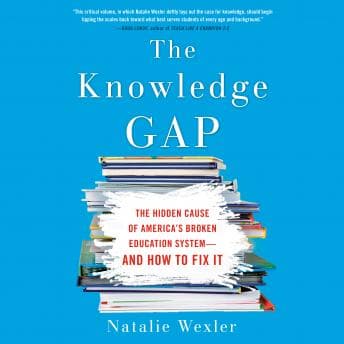

What if the single biggest problem in American education isn't funding, isn't teachers' unions, isn't standardized testing - but that we've been teaching reading wrong for decades?
I was on a red-eye back from a client engagement in Austin, couldn't sleep, and figured I'd knock out something from my queue. Nine hours later - okay, four and a half at my speed - I was genuinely angry. Not at the book. At the system Natalie Wexler describes. And at myself for not connecting the dots sooner.
My Parents Already Knew This (They Just Called It Common Sense)
Here's the core argument: American elementary schools have spent years drilling kids on "reading comprehension skills" - find the main idea, make inferences, identify the author's purpose - using random, disconnected passages about dolphins one day and volcanoes the next. The assumption is that reading is a transferable skill, like riding a bike. Wexler's point, backed by cognitive science research, is that it's not. Comprehension depends on background knowledge. You can't "find the main idea" if you don't know anything about the topic.
This is what my parents did instinctively. Now it has a TED talk. My mom used to sit me down with Korean history books and encyclopedias before I ever touched a novel. She didn't have an education degree. She had a dry cleaning business and the conviction that you need to know things to understand things. Meanwhile, American schools were busy teaching kids to "use context clues" on passages about subjects they'd never encountered. The Enlightenment thinkers wrestled with a version of this same question - what does it actually mean to educate a mind versus merely train one - and Answering the Question: What is Enlightenment? puts that tension in useful historical relief.
Wexler follows real classrooms - one in D.C. where a teacher named Ms. Arredondo is trying to implement a content-rich curriculum, and another where the old skills-based approach grinds on. The contrast is painful. In the content-rich classroom, kids are building knowledge about the War of 1812, ancient civilizations, the human body - and their reading scores improve as a byproduct. In the skills-focused room, kids practice "strategies" on throwaway texts and flatline. The scenes where students in low-income schools are excited - genuinely excited - to discuss Mesopotamia hit different when you've spent your career watching companies fail because leadership confuses process with substance.
The Consulting Parallel That Kept Me Up
I've seen this exact failure pattern at three different companies. Management invests in "skills training" - leadership workshops, communication seminars, team-building retreats - while ignoring the actual domain knowledge people need to do their jobs. Then they're shocked when nothing improves. Wexler documents the education version: billions poured into reading programs that teach the metacognitive wrapper without ever filling the box with anything worth wrapping.
The history section is where the book earns its keep. Wexler traces how we got here - the progressive education movement, the well-intentioned but misguided emphasis on "critical thinking" as a standalone skill, the way standardized testing reinforced the problem by rewarding strategy over knowledge. It's a clean, well-sourced argument. Not perfect - some listeners have pushed back on whether she substantiates every claim as rigorously as she could, and I'll grant that she occasionally leans hard on the same research without enough counterpoint. But the central thesis is solid and the evidence she does present is specific enough to be actionable.
The Narration Situation
Wexler narrates her own book. This is always a gamble. She's not a professional narrator, and you can tell - there's a flatness that creeps in during the research-heavy sections, and she doesn't shift vocal register much between the classroom scenes and the policy analysis. But here's the thing: she knows this material cold. The conviction comes through. When she's describing what she saw in those D.C. classrooms, you're getting the journalist's own voice, her own frustration and hope. That authenticity is worth the trade-off. I wouldn't call it a riveting performance, but I'd call it an honest one.
At 2.0x, the pacing worked fine. The writing is clean enough that acceleration doesn't turn it into mush, which tells you something about the prose quality. Most business and policy books fall apart above 1.75x because the sentences are too convoluted. Not this one.
Who Gets the Invoice
If you're a parent, a teacher, or anyone who's ever wondered why American kids can decode words but can't understand what they're reading - this is your book. If you're in education policy, it should be required. If you're a consultant like me who thinks organizational dysfunction follows the same patterns regardless of sector, you'll find uncomfortable parallels everywhere.
Skip it if you want solutions served on a silver platter. Wexler describes what's working in a few schools, but this is more diagnosis than prescription. The fix is conceptually simple (teach kids actual content) and operationally brutal (change everything about how elementary curricula are designed, how teachers are trained, and how tests are written).
Bottom Line: The ROI on 9 Hours
The key takeaway is worth the listen. The other 7 hours? Actually, most of them earn their keep too, which is rare for this category. Wexler respects your time more than 90% of education writers. She makes her point, supports it, shows you real people living it, and doesn't pad. My parents would appreciate that efficiency, even if they'd also point out they figured this out forty years ago without a book deal.
Jenny would say I'm being harsh on author-narrators. Jenny is right. But I'm still giving this a strong recommendation. Some books change how you see a problem. This one changed how I see an entire system.