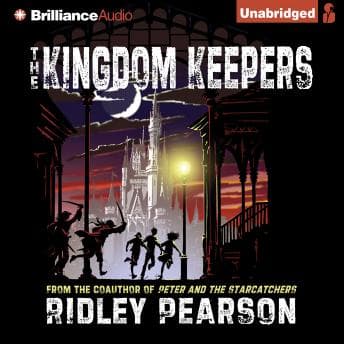

What happens when you feed a Disney IP into a middle-grade sci-fi blender and hit puree? You get Kingdom Keepers, and honestly, the results are more interesting than I expected - even if this is very much not my usual lane.
I picked this up because Kevin's niece wouldn't stop talking about it over Thanksgiving, and I figured at 6 hours it was basically a single commute day plus a lunch break. I started it on a Wednesday morning at 6:15 AM, half-conscious on the Caltrain with my coffee doing absolutely nothing yet, and here's the thing - the premise actually kind of slaps from a tech perspective.
The DHI System Is Basically Kubernetes for Theme Park Holograms
Okay, hear me out. Five kids get scanned to become holographic park guides - Disney Host Interactive - and then discover they're being projected INTO the park at night while they sleep. Their physical bodies are asleep at home, but their hologram selves are wandering Magic Kingdom after hours. As someone who spends her days thinking about distributed systems, the concept of your consciousness being deployed to a remote instance while your local machine is in sleep mode? That's... actually a fun thought experiment. Ridley Pearson doesn't go deep on the tech (it's a kids' book, Sarah, calm down), but the DHI framework raises cool questions about state management and identity that I genuinely enjoyed chewing on between station stops.
The plot itself is straightforward: Disney villains - Maleficent, the works - are coming alive and threatening the park, and these five kids have to stop them using their hologram abilities. Finn Whitman is your classic reluctant hero, a middle-schooler from Orlando who didn't sign up for any of this. The mystery of who's behind the villain uprising gets a little convoluted in the middle stretch, and I'll be honest, I zoned out during one section around hour 3 where the kids are running between park attractions and I couldn't quite track the geography. That might be a me-at-6AM problem or a pacing problem. Probably both.
Gary Littman: The Polarizing Deploy
So here's where this gets interesting. Littman's narration is one of those love-it-or-hate-it situations, and I land somewhere in the middle. His voice for Finn actually works - he sounds like a real middle-schooler, not an adult doing a cringey kid impression. And he differentiates the five main kids well enough that I could track who was talking without rewinding, which on a packed morning train is the minimum viable product for narration.
But some of his accent work? Oof. There are moments where character voices tip from "distinct" into "cartoon character doing a bit," and I caught myself wincing a couple times. It's the kind of performance where you can feel the narrator reaching for something ambitious and not quite sticking the landing. I've seen reviews calling the narration outright bad, and I've seen others praising it as fun and engaging. I think the split comes down to tolerance: if you're listening with kids who love big character voices, Littman's approach probably lands. If you're a solo adult listener at 1.5x speed trying to follow plot threads, the over-the-top moments can grate.
I bumped it down to 1.25x for this one, actually. At my usual 1.5x, some of Littman's voice transitions were blurring together.
Who Should Queue This Up (And Who Shouldn't)
Perfect for: road trips with kids, family listening, Disney park fans who want a bedtime story with their favorite IP. This is basically Ready Player One but for the Disney theme park generation, pitched at 10-to-14-year-olds.
Skip for: adults looking for their next sci-fi fix. I went in knowing this was middle-grade and adjusted expectations accordingly, and that's the only reason I enjoyed it. If you're coming off Project Hail Mary or Children of Time expecting hard sci-fi, you will be deeply disappointed.
The ROI on this audiobook is modest but real - it's short, the premise is genuinely creative, and it scratches a very specific Disney-nostalgia itch. Kevin's niece was right that the after-dark park concept is cool. She was wrong that it's "the best book ever written," but she's eleven, so I'll allow it. The last time I felt this kind of "this is objectively fine but not what I needed" energy was with Tenth Circle — another book I picked up on someone else's recommendation and finished with a shrug and a grudging "okay, I see it.".
Commute-Worthiness: Conditional Pass
I finished this in two commutes and a lunch break. It held my attention well enough on the morning leg but wouldn't survive my most sleep-deprived 6 AM states. The narration polarization is real - I'd suggest sampling a chapter before committing a credit. For adults, this is a borrow-or-stream situation. For families, it's a solid pickup that'll keep kids engaged on a long car ride and maybe - just maybe - make them think about what "hologram" actually means.