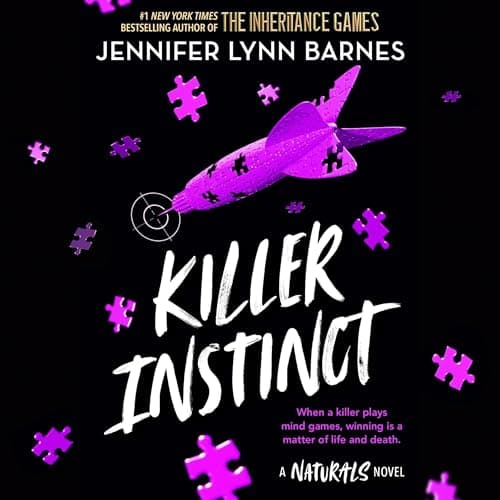

Look, I need to rant about something before we get into this. Cassie Hobbes keeps getting rescued. I know this. Barnes knows this. The YA gods know this. And yet here I am, having burned through nine and a half hours on a Tuesday night while reshelving returns at the library after close - headphones in, motion-sensor lights flickering off every few minutes because I was standing too still in the stacks - completely and utterly hooked. The girl gets rescued, and I still couldn't stop listening. That's either a damning indictment of my taste or a compliment to Barnes's plotting. Probably both.
Criminal Minds Got a YA Scholarship and I'm Not Mad About It
So here's the setup for anyone new to the Naturals series: the FBI recruits teenagers with freakish cognitive abilities - profilers, human lie detectors, statisticians who see patterns in chaos - and points them at cold cases. Book two drops a copycat killer into the mix who's replicating the murders of Dean's imprisoned father, and suddenly these kids aren't safely theorizing from their government-funded group home. They're in it.
Barnes has advanced degrees in psychology and cognitive science, and you can feel that in how Cassie's profiling works. This isn't TV-magic "I can read your soul" nonsense. When Cassie slips into a killer's headspace, it's structured around actual behavioral analysis - the way she builds a profile layer by layer, questioning her own assumptions, getting it wrong sometimes. As a librarian who's catalogued more true crime than anyone should admit to, I appreciated that Barnes respects the methodology even while wrapping it in a thriller bow.
The copycat angle is where things get genuinely unsettling. Dean's relationship with his father's legacy - trying to separate who he is from who made him - that's where the real horror lives. Not in the body count. In the dread of recognizing yourself in a monster. Barnes gets that horror isn't about gore - it's about dread. She may be writing for teens, but she's not pulling punches on the psychological weight.
What frustrated me - and I say this with affection - is the rescue pattern. Cassie is sharp, perceptive, capable of reading people better than trained agents, and then the climax rolls around and she needs saving. Again. It's the one structural weakness that keeps this from hitting harder, because Barnes has built a protagonist who should be capable of saving herself by now. Book two. Come on.
Amber Faith Understands the Assignment
The narrator commits. That's rare. Amber Faith cycles through accents for different characters, and what impressed me isn't just that she does it - plenty of narrators attempt character voices - but that she's consistent. The accent she gives one character in chapter two is the same accent in chapter twelve. I noticed the same narrator discipline — or painful lack of it — when I reviewed Splintered, where the voice work either makes or breaks the whole atmospheric house of cards. When you're juggling a cast of teenagers who all think they're the smartest person in the room, that consistency is the difference between following the conversation and rewinding every three minutes.
Her Cassie is measured without being flat - there's this quality of someone who's always watching, always processing, and Faith catches that analytical distance in her delivery. She pulls back slightly during profiling sequences, gets quieter, and it works because it mirrors how Cassie retreats into her own head. It's a subtle choice that a lesser narrator wouldn't even think to make.
I don't have specific complaints about the audio production. Single narrator, clean audio, no distracting music or sound effects to break immersion. For a suspense-heavy listen, that's exactly right. Let the tension live in the silence between sentences.
The Dread Ratio
Here's what I keep circling back to: Barnes is writing YA thrillers that function like genuine crime fiction. The plot twists aren't cheap - they're set up, they earn their reveals, and at least one of them genuinely caught me off guard (which, after 200+ episodes of my podcast dissecting horror and thriller structures, doesn't happen often). The team dynamics carry real weight. Michael's emotional reading, Lia's deception detection, Sloane's statistical brain - they're not just gimmicks. They're lenses through which the mystery refracts differently.
But I want to be honest: this is solidly YA. The romance subplot takes up real estate. The angst is present. If you're coming to this expecting the darkness of, say, actual FBI procedurals, you'll find the edges softened. That's not a flaw - it's the genre doing its job. Barnes knows her audience and writes to them brilliantly. Just know what you're walking into.
Who should listen? Anyone who loves criminal profiling fiction but wants it filtered through sharp, competitive teen dynamics - think Criminal Minds meets a gifted-and-talented program. Who should skip? If YA romance subplots make you impatient, or if you need your protagonists to rescue themselves, this particular itch won't get scratched.
I listened in the dark. Mistake? Maybe. Worth it? Absolutely. Those motion-sensor lights clicking off every few minutes while I stood frozen in the stacks, lost in a copycat killer's pattern? Shirley Jackson walked so Barnes could sprint in a different lane entirely - YA thriller instead of literary horror, but the understanding of psychological tension is there.
Shelve This Under "Surprisingly Sharp"
My podcast listeners are going to love this recommendation, even if some of them will side-eye me for covering YA. Barnes is doing real work with criminal psychology, Amber Faith's narration keeps pace with the suspense, and the copycat killer premise gives this installment genuine teeth. The rescue problem is real, and the YA romance pacing won't work for everyone. But for a nine-and-a-half-hour listen that kept me standing motionless in a dark library? I'll take it.