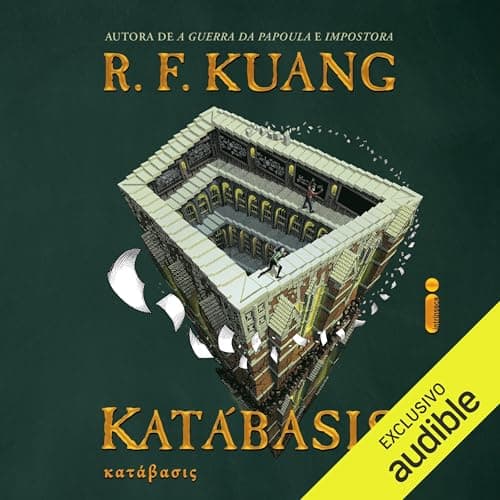

R.F. Kuang wrote a Dante's Inferno retelling set in the pressure cooker of Cambridge academia, and honestly? I'm furious I didn't think of this first.
I was shelving returns at the library on a Tuesday evening — one of those gray Oregon evenings where the fluorescent lights feel oppressive and the building is almost empty — when I decided to start this in my earbuds. Twenty hours later, I'm writing this review at midnight with Shirley curled on my keyboard, and I haven't stopped thinking about the fact that Kuang basically turned a PhD program into a literal descent into Hell. Because that's what this is. Alice Law's advisor dies during a routine magical experiment, she might be responsible, and her only path forward is to follow him into an underworld that operates on the logic of Dante's circles — except filtered through both Greek and Chinese mythology, which gives the whole thing this unsettling quality where you're never sure which set of rules applies.
The Academy Is Already Hell — Kuang Just Made It Literal
Here's what Kuang understands that so many fantasy authors don't: the real horror isn't in the demons or the tribunals that expose human sin. It's in the power dynamics. Alice has sacrificed everything — pride, relationships, mental health — to work under Professor Jacob Grimes, a man she doesn't even like. And when he dies and ends up in the underworld, she doesn't go after him out of love or loyalty. She goes because her entire future, her academic career, her identity is tethered to this man's legacy. That's the kind of horror that sits in your chest. Kuang is working in the same territory she explored in Babel — institutional power structures that consume the people inside them — but here she's sharpened it into something more personal, more claustrophobic.
Babel is where Kuang first convinced me that a translation school could be the most terrifying institution in fiction — and I haven't fully recovered from it.The dynamic between Alice and Peter Murdoch, her academic rival who independently decides to make the same journey, is where the book really breathes. They're both brilliant, both damaged, both navigating an underworld with chalk pentagram magic and centuries-old literary texts as their only guides. The fact that their tools are essentially scholarly — Dante's writings, Orpheus's myth — is such a pointed choice. These are people who have spent their lives believing that knowledge is power, and the Inferno keeps proving them wrong.
Ana Amélia Vianna and the Portuguese Question
I need to be upfront: this audiobook is in Portuguese. My Portuguese is... functional. I lived with a Brazilian roommate for a year in college, I can follow conversation, and I've listened to enough Portuguese-language media to keep up with a narrative this well-structured. But I'm reviewing this with that caveat. Ana Amélia Vianna's narration has a quality I respond to — there's a dryness to how she handles Alice's internal monologue that matches the book's caustic tone. Alice is not a warm protagonist. She's sharp, self-aware in that brutal academic way where you can diagnose your own dysfunction but can't stop it, and Vianna captures that without tipping into coldness. The moments in the Inferno's tribunals — where human sins are laid bare — land with the right weight.
I can't evaluate pronunciation precision or accent consistency the way I would with an English-language narrator, so I'm keeping my narrator rating conservative. What I can say is that the pacing felt right for a 20-hour listen, and Vianna didn't lose me in what is essentially a two-character journey through increasingly bleak territory.
Horror That Wears an Academic Gown
What I keep coming back to is how Kuang uses the structure of a katabasis — the mythological descent — to interrogate misogyny in academia. Alice isn't just fighting demons. She's fighting the system that told her she had to destroy herself to be worthy. The Inferno she traverses isn't the medieval Christian punishment fantasy. It's stranger, more syncretic, pulling from Chinese underworld mythology in ways that destabilize the Western framework Alice (and the reader) expects. When the rules shift underneath you, when Dante's map stops working and something older takes over — that's where the real dread lives.
Shirley Jackson walked so R.F. Kuang could run. Not because the prose styles are similar, but because both writers understand that the most terrifying thing isn't what's in the dark. It's what you've done to yourself to survive.
That same excavation of self-destruction in service of survival is what makes Katábasis feel less like fantasy and more like a document — the kind you find in a drawer and aren't sure you were meant to read.Who Should Listen (And Who Should Skip)
If you're a Kuang fan who loved Babel's institutional critique and want it turned inward, this is your book. If you need fast-paced action and find academic settings claustrophobic in a bad way, this will feel like 20 hours of suffocation. And if you don't speak Portuguese — look, I'm not going to pretend that's not a significant barrier. But if you can handle it, or if you're waiting for the English audiobook, know that the source material is Kuang at her most ambitious and her most vicious.
I listened in the dark. Mistake? Maybe. Worth it? Absolutely. My podcast listeners are going to love this — I'm already planning a Katábasis episode that cross-references Chinese underworld mythology with Dante. Shirley (my cat) was unimpressed. I was terrified. Not by monsters, but by how precisely Kuang captures what it feels like to destroy yourself for someone else's approval.