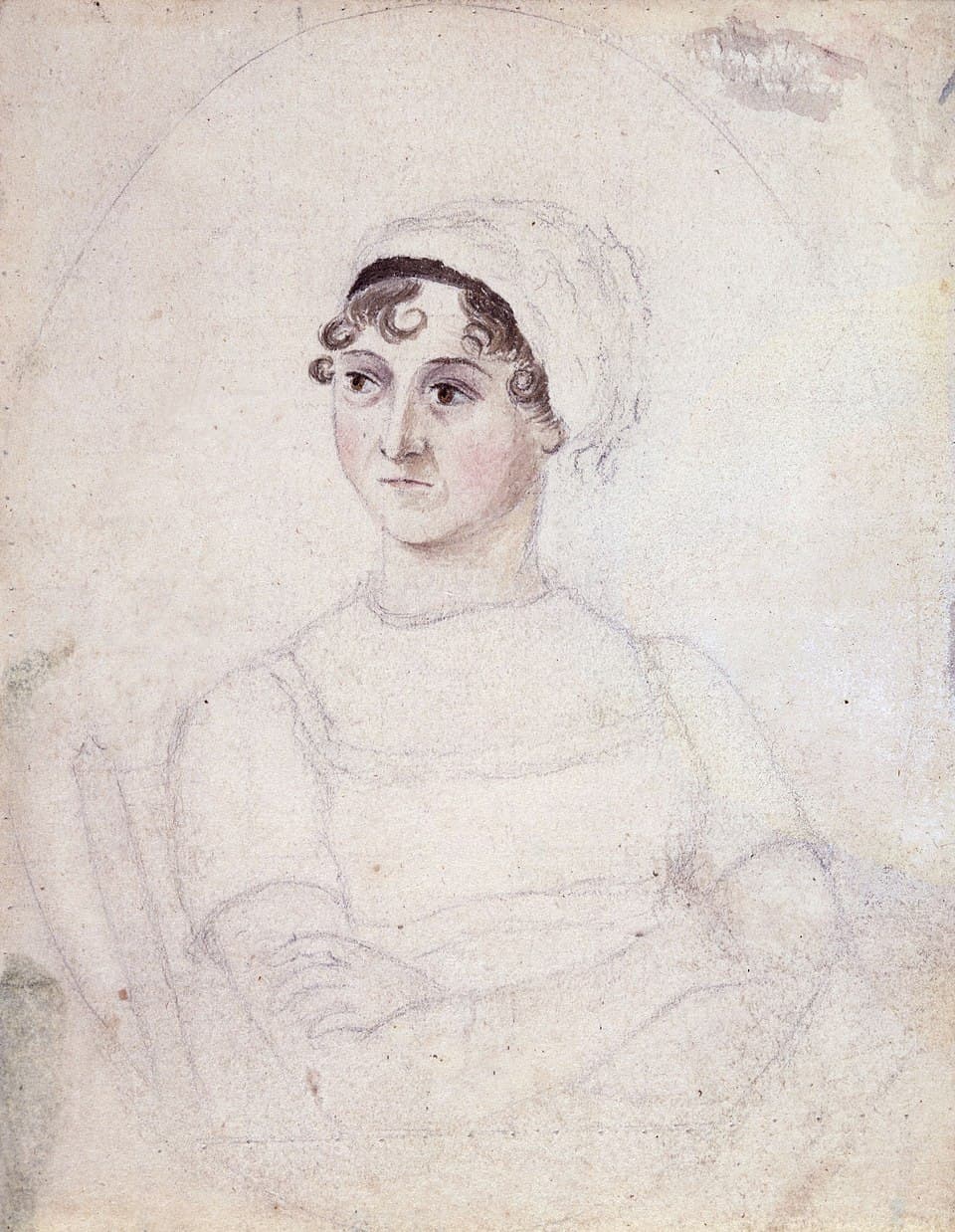

Look, I have a complaint. For twenty years I've been telling students that Jane Austen was a serious literary figure, a careful observer of human nature, a master of irony. And then I listen to her juvenilia and discover that at fifteen, she was basically writing Regency-era shitposts.
I mean this as the highest compliment.
The Teenager Who Would Be Austen
I was grading essays at 11PM—the usual Thursday night ritual—when I put this on expecting something scholarly, something that would make me feel cultured while marking papers about The Great Gatsby that all somehow manage to say "the green light represents hope" as if it's a revelation. What I got instead was Jane Austen at her most unhinged, mocking every gothic novel and sentimental romance she'd ever read. Love and Freindship (yes, she spelled it that way, and no, I'm not going to pretend she was being clever about it—she was fifteen and spelling was optional) features heroines who faint at the slightest provocation, die from "a galloping consumption," and deliver speeches so melodramatic they'd make a soap opera writer blush.
This is the literary equivalent of finding out your most proper colleague used to be in a punk band. I got that same delightful whiplash reading Before We Were Yours, where Lisa Wingate takes historical material and makes it feel immediate and personal instead of distant and academic.
The History of England is particularly delicious—Austen dismisses entire monarchs in a sentence or two, declares her biases openly ("I am a partial, prejudiced, & ignorant Historian"), and basically writes the kind of irreverent take on history that would get a student sent to my office today. She loved Mary Queen of Scots and hated Elizabeth I, and she wasn't subtle about it. Denise, walking beside me on the lakefront Saturday morning, asked why I kept laughing. I tried to explain that a teenage girl in 1791 was roasting Henry VIII with the same energy as a Twitter thread. She nodded politely. She was listening to a true crime podcast.
The LibriVox Reality
Here's where I have to be honest with you. This is LibriVox, which means volunteer readers of wildly varying quality. Some sections—particularly Lady Susan, which is genuinely sophisticated epistolary fiction—deserve a professional narrator who can differentiate between Lady Susan's calculated manipulation and her daughter's naive distress. What you get instead is a rotating cast doing their earnest best. Some readers handle the satirical tone beautifully, catching Austen's deadpan humor. Others read it straight, which... misses the joke entirely.
It's free. It's on Archive.org. You get what you pay for.
But here's the thing—and this is why I'm not telling you to skip it—the material is so inherently entertaining that even uneven narration can't sink it. When young Austen writes about a character who dies "alternately on a Sofa" (because apparently you can't just die once, you have to keep doing it for dramatic effect), the comedy survives any delivery. The prose deserves to be savored, even when the savoring is occasionally interrupted by a reader who pronounces "shan't" like it's a foreign word.
Who Gets This (And Who Won't)
If you love Austen's novels and want to understand where that razor wit came from—this is essential. You can hear her practicing, finding her voice, learning to weaponize politeness. Lady Susan in particular feels like a dress rehearsal for her later villains, a manipulative widow who is genuinely, entertainingly awful.
If you're expecting the refined Austen of Pride and Prejudice—adjust your expectations. This is juvenilia. Some pieces are brilliant. Some are clearly exercises. The shorter works especially can feel like fragments, sketches, ideas that never quite developed. At just under six hours, it's not a massive commitment, but it does require patience. Skip this if you need polish over personality, or if inconsistent audio quality will drive you up a wall.
My students would hate this. The language is dense, the jokes require context, and nothing explodes. I love it. Worth pausing the faculty meeting for—though honestly, I'd pause the faculty meeting for a grocery list.
Professor's Final Grade
This reminds me of what Hemingway said about writing—you have to write a million words of garbage before you write anything good. Except Austen's "garbage" is funnier than most people's finished work. The LibriVox production is uneven, the material is inconsistent, but there's something genuinely thrilling about hearing a genius figure out how to be a genius. Stream it for free, listen while doing something else, and forgive the rough edges. The diamond underneath is worth digging for.