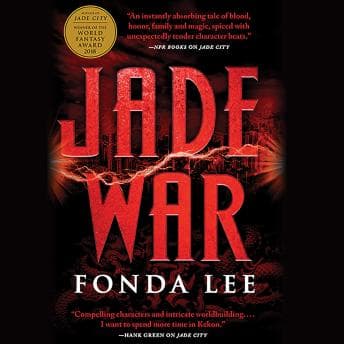

Jade War is The Godfather meets wuxia, and I mean that as the highest possible compliment.
I finished Jade City during a particularly brutal on-call rotation last year - there's something about mafia family drama that pairs well with 3AM production incidents, don't ask me why. So when I started the sequel on a Monday morning commute, I expected more of the same. What I got was a 24-hour epic that made me genuinely angry when my train pulled into Mountain View because I had to stop listening.
The Scope Creep That Actually Works
Here's the thing about book two in a trilogy: it's usually setup. Filler. The "Empire Strikes Back" comparison gets thrown around, but most sequels are really just "here's some stuff happening before the real ending." Jade War is different. Fonda Lee basically says "you thought this was a story about one city? Cute. Let me show you the whole geopolitical chessboard."
The Kaul family's problems in book one were local - rival clans, street-level territory disputes, the kind of honor-bound violence that stays in the neighborhood. Book two pulls the camera back. Foreign governments want Kekon's jade. Criminal organizations want a piece. Suddenly the No Peak clan isn't just fighting for Janloon - they're navigating international politics, smuggling operations, and the slow realization that the old ways might not survive the modern world.
This is basically a startup scaling story, but for crime families. The scrappy operation that worked when you were small? Doesn't scale. The values that defined you? Get tested when survival requires compromise. I've watched this play out in tech companies. Watching it play out with supernatural martial artists is way more entertaining.
Andrew Kishino Carries 24 Hours Like It's Nothing
Twenty-four hours is a commitment. That's like... 16 commutes for me. And the research I did before starting mentioned Kishino's "tone and grittiness" matching the story's texture, which - okay, kind of vague, right?
But it's accurate. There's this quality to his voice that sounds like someone who's seen some things. Not harsh, not overdoing the tough-guy energy, just... weathered. The Kaul siblings all sound distinct - Hilo's barely-contained intensity versus Shae's controlled corporate precision versus Anden's uncertainty. You can close your eyes and know who's talking, which matters when you're half-asleep on a packed train.
The ROI on this audiobook is excellent purely because Kishino makes 24 hours feel sustainable. No weird pronunciation choices that pull you out. No moments where you're like "wait, who said that?" Just consistent, solid performance that lets the story do its work.
Where It Drags (Because 24 Hours Is Still 24 Hours)
Look, I'm not going to pretend every minute is riveting. There are political maneuvering sections that - while important for the plot - had me bumping up to 1.75x speed. Some of the international subplot stuff takes a while to pay off. If you're coming for pure action, you'll get it, but you'll also get a lot of meetings and negotiations and strategic planning.
But here's the thing: the payoffs are worth it. When the violence does hit, it hits harder because you understand the stakes. You've spent hours watching these characters make impossible choices, and then consequences arrive like a freight train. I actually gasped out loud during one scene toward the end. On a crowded Caltrain. Got some looks.
Who This Is For (And Who Should Bail)
This is not a background listen. The political complexity requires attention. The character web is dense enough that zoning out for 10 minutes means missing important relationship dynamics. That same level of attention paid off for me with Beekeeper of Aleppo, another story where the emotional stakes demand your full focus. But if you've got a long commute and you want something that'll make those hours disappear? This is it.
Skip if: You want standalone stories, you haven't read Jade City (seriously, don't start here), or you need constant action to stay engaged.
Shipping to Production
Jade War does something rare - it's a middle book that feels essential rather than transitional. The stakes are higher, the scope is bigger, and somehow the family drama gets more personal even as the story goes global. Fonda Lee is a former corporate strategist and it shows - the way she maps out power structures and political maneuvering feels real in a way that most fantasy political intrigue doesn't.
I finished this in about two and a half weeks of commutes. I immediately bought Jade Legacy. That's the only recommendation that really matters.