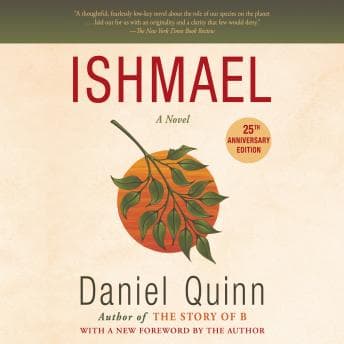

Look, I need to rant for a second. A telepathic gorilla. A TELEPATHIC GORILLA is the vehicle Daniel Quinn chose to deliver what is essentially a philosophy lecture about why agricultural civilization was a mistake, and somehow — somehow — it works? I'm actually a little mad about it. I've spent three years trying to make procedural generation sound interesting in my thesis, and this guy just said "what if gorilla teaches man about culture" and won a fellowship. The audacity. The beautiful, beautiful audacity.
I was deep into a board game solo session — Mage Knight, if you're curious, because apparently I hate myself — when I threw this on expecting background listening material. Nope. By the second chapter I'd abandoned the game entirely because Quinn's structure demands your actual brain. Ishmael the gorilla is conducting what amounts to a Socratic dialogue with an unnamed narrator, and the whole thing operates through telepathy, which sounds absurd on paper but in practice creates this weirdly intimate back-and-forth that pulled me completely out of tile placement and into existential crisis territory.
A Gorilla Running a Philosophy Seminar (And You're the Student)
Here's what Quinn actually does that's clever: he splits all of humanity into "Takers" and "Leavers" — agricultural civilizations versus indigenous/hunter-gatherer cultures — and then has Ishmael methodically dismantle the mythology that Takers tell themselves about why they're the pinnacle of creation. It's not subtle. Quinn is not interested in subtlety. The gorilla literally walks you through the Book of Genesis as an allegory for the agricultural revolution, reframing Cain and Abel as a story about farmers killing pastoralists. And I sat there on my apartment floor surrounded by Gloomhaven boxes thinking "oh no, the gorilla has a point."
The didactic style is going to lose some people. I need to be honest about that. This is basically a Socratic dialogue wearing a novel's skin — there's barely a plot, the unnamed narrator is more of a question-asking device than a character, and if you came here for action or even traditional storytelling, you will be deeply confused. It's closer to Sophie's World than Sanderson. But if you've ever sat around a D&D table at 2 AM arguing about whether civilization in your homebrew world would develop differently without agriculture — and yes, my group has done this, we are exactly that kind of nerd — then Quinn's framework is going to light up your brain like a nat 20.
The progression is satisfying in a way I didn't expect. Each dialogue session builds on the last, and Ishmael keeps pulling the rug out from under assumptions you didn't even know you had. The "Mother Culture" concept — this idea that we're all swimming in a cultural narrative so pervasive we can't see it — that one stuck with me for days.
Morgan Freeman Voices a Telepathic Gorilla and Yes, It's Exactly What You Think
Two narrators here: Kirby Heyborne handles the human narrator, and Morgan Freeman is Ishmael. And look — Morgan Freeman voicing the telepathic gorilla philosopher is almost unfair casting. His delivery during the philosophical dialogues has this patient, measured weight that makes you feel like you're actually sitting across from something ancient and wise. The telepathic dialogue sections land with striking clarity; you always know who's "speaking" even though technically nobody's speaking at all.
Heyborne plays the student role well — there's an earnestness to his delivery that keeps the human narrator from feeling like a total blank slate. But let's be real, you're here for Freeman's gorilla, and Freeman's gorilla delivers.
At 8 hours 43 minutes, it's a lean listen. No bloat. Quinn says what he needs to say and gets out, which I respect even as someone who will happily commit to a 40-hour epic.
Who This Is Actually For (And Who Should Run)
If you want a traditional novel with character arcs, rising action, and a climax — skip this. Seriously. You will hate it. This is a philosophy book cosplaying as fiction, and it doesn't try very hard to hide it.
But if you're the person in your friend group who gets excited about worldbuilding not just for the cool magic systems but for the underlying cultural logic — the "why does this civilization work this way" questions — Ishmael is going to hit different. My D&D group would love this, specifically for the arguments it would start about how we design fictional societies. Though honestly, the arguments my group gets into about fictional societies pale compared to the kind of stakes-driven character work in something like Golden Girl, where the worldbuilding is quieter but the cultural assumptions Quinn would absolutely have opinions about are baked into every page.
I read this instead of writing my thesis. Dr. Patel, if you're reading Audiobooks4soul reviews instead of checking on my chapter draft, we both have problems.
The Gorilla Was Right and I'm Not Okay About It
Ishmael isn't going to change your life the way the blurbs promise. But it might genuinely change one or two assumptions you've never questioned, and for an 8-hour audiobook with Morgan Freeman voicing a philosophical primate, that's a pretty solid return on investment. Not a must-listen for everyone, but for the right listener — the kind who pauses audiobooks to go look things up — it's absolutely worth the credit.