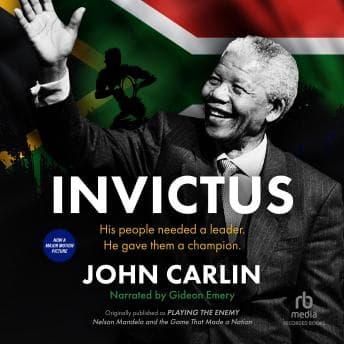

Three in the morning, couldn't sleep - one of those nights where the brain just won't shut down. Linda was out cold, Ranger was snoring at the foot of the bed, and I figured I'd knock out a couple hours of my queue instead of staring at the ceiling. Turned out to be the right call. There's something about listening to Mandela's story in the dark, in complete quiet, that strips away all the Hollywood polish and lets the weight of it settle on you.
Let me cut to the chase: this is one of those rare books where the true story is more improbable than anything a novelist would dare write. And Carlin - a journalist who actually covered South Africa during the transition - knows how to tell it without turning it into hagiography.
The Play Nobody Would've Drawn Up
Here's what got me. Most people know the broad strokes from the Clint Eastwood film. Mandela uses rugby to unite South Africa. Springboks win the World Cup. Credits roll. But Carlin's book operates at a completely different level of detail, and that's where the real story lives.
The thing that floored me wasn't the rugby - it was the political maneuvering. Mandela walking into both dressing rooms before that 1995 final, wearing the Springbok jersey with Pienaar's number 6 on his back. You have to understand what that jersey meant. For Black South Africans, the Springboks were the enemy's team. They'd cheered for whoever was playing against South Africa for decades. And here's their president, the man who spent 27 years in prison because of what that jersey represented, putting it on like it was nothing. Except it wasn't nothing - it was the most calculated piece of strategic communication I've ever encountered, military or civilian.
I've seen this scenario play out in real life - not at that scale, obviously, but the principle of winning over your opposition by meeting them on their territory. Every counterinsurgency manual talks about winning hearts and minds, and most of them are full of it. Mandela actually did it. With a rugby jersey and a handshake.
Where Carlin Earns His Stripes
The author clearly did their homework, and it shows in a specific way - he doesn't just tell you what happened, he reconstructs the political chess game behind every public gesture. You get Mandela's security team freaking out about him visiting Betsie Verwoerd, the widow of the architect of apartheid. You get the internal ANC debates about whether embracing the Springboks was a betrayal. Carlin had access to the people who were in those rooms, and it elevates the whole thing from sports narrative to political thriller.
That said, this is where it lost me a few times: the rugby play-by-play sections. I'm a football guy, American football, and rugby tactics don't land with the same clarity for me. There are stretches where Carlin goes deep into the tournament mechanics, and if you're not a rugby person, your attention drifts. Not fatally - we're talking maybe 15-20% of the book - but it's there.
Gideon Emery handles narration duty solo, and he's solid. Clean delivery, good pacing, and he clearly understands the material. I didn't get much in the way of distinct character voices - it's more of a journalistic read than a dramatic performance - but for nonfiction like this, that's the right call. You don't need someone doing a Mandela impression. You need someone who can carry the gravity of the subject without getting in the way of it. Emery does that. At 1.25x he was perfectly calibrated.
At nine hours and change, it's the right length. Doesn't overstay its welcome, doesn't rush the setup. Carlin gives you enough background on apartheid to understand the stakes without turning it into a history textbook.
Who This Is Actually For
If you've only seen the movie, you're operating with about 30% of the picture. The film is fine - Matt Damon and Morgan Freeman did their jobs - but it's Hollywood. Carlin's book is the intelligence brief the movie was based on. You want the real operation? This is it.
Anyone interested in leadership, political strategy, or how one person can redirect the trajectory of a nation - this is your book. Military folks will appreciate the strategic thinking even if they don't care about rugby. Sports fans who want more than just game recaps will find the political context fascinating.
Skip it if you need constant action. This is cerebral. It builds. The payoff is enormous, but you've got to trust the process.
Ranger and I Call This One a Win
Worth your time? Here's the debrief: Mandela pulled off something that no military operation, no diplomatic summit, no treaty could have accomplished - he made bitter enemies see each other as countrymen over a single rugby match. And Carlin captured it with the precision of someone who was actually there. I finished it at 5 AM, wide awake, thinking about what real leadership looks like. Ranger slept through the whole thing, but I'm counting his silence as approval. Mission accomplished. The only other memoir I've come across recently that made me sit with that same wide-awake-at-dawn feeling was Riding the Elephant — completely different subject matter, but that same quality of a man taking honest stock of what power costs and what it reveals about character.