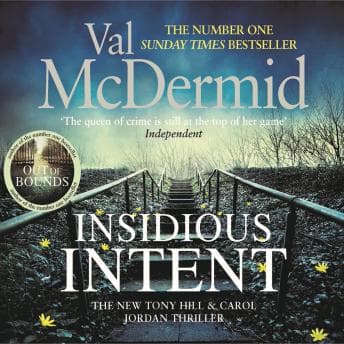

Look, I have a complaint. Seven books into a series and Val McDermid still won't let Tony Hill and Carol Jordan just be happy. I know, I know - happiness doesn't sell crime fiction, and misery is the engine that drives great character work. But I've been with these two since book one, and listening to them circle each other while a serial killer burns women alive in cars felt like watching my juniors try to ask each other to prom. Except with significantly more forensic pathology.
I finished this one during a Saturday morning walk along the lakefront with Denise, which in retrospect was a poor choice. There's something deeply unsettling about listening to descriptions of charred remains while joggers smile at you and the sun glints off Lake Michigan. Denise kept asking why I looked so disturbed. I told her it was the wind.
The Killer Who Thinks He's Smarter Than Everyone (He's Not Wrong Enough)
What McDermid does well here - and she's been doing it for three decades, so she should - is construct a villain whose logic is almost reasonable. The killer in Insidious Intent targets women through dating sites, which in 2017 felt prescient and now feels like Tuesday. He's meticulous, he's patient, and he genuinely believes he's left no trace. The burned cars aren't just murder weapons; they're erasure. He's trying to eliminate identity itself.
The menace here has what Hemingway called the dignity of movement of an iceberg - most of it below the surface. McDermid doesn't give you a mustache-twirling psychopath. She gives you someone who plans dates, makes conversation, and then does something monstrous. The banality is the horror. Most readers want their villains loud. I love it precisely because he's quiet.
But here's where some longtime readers have pushed back, and I partially agree: the investigation itself doesn't crackle the way earlier books did. The team dynamics feel a bit procedural - not in the good Wire way, but in the "we're checking boxes" way. There's a subplot involving a mole within the unit that should generate tension but mostly generates meetings. I've sat through enough faculty meetings to know that meetings rarely generate anything useful.
Saul Reichlin Knows When to Disappear
Reichlin has been narrating this series long enough that he IS these characters for me. His Tony Hill has this slightly hesitant quality - the pauses before Tony commits to a theory, the way his voice tightens when Carol pushes back on his profiling. It's not flashy work. It's the kind of narration where you forget someone is reading to you, which is the highest compliment I can give.
His British accent carries the right weight for McDermid's Yorkshire-set procedurals. There's a warmth there that keeps thirteen hours from feeling like a slog. Where I wanted more - and this is a minor gripe - was in differentiating the supporting cast. The newer team members sometimes blurred together for me, voices not quite distinct enough to immediately place who was speaking in group scenes. With a cast this large, that's a real challenge, and Reichlin handles it competently if not brilliantly.
When the story reaches its final act - and that ending genuinely caught me off guard - Reichlin doesn't oversell it. He trusts the material. The pacing stays controlled even as the revelations pile up. One reviewer called it "a home run with an ending that knocks it out of the park," and while I'd resist the baseball metaphor (I'm a lit teacher, not a sports guy), the sentiment is right. The last two hours earned the previous eleven.
Who Gets Burned, Who Gets Spared
If you've read the first six Hill/Jordan books, you're listening to this regardless of what I say. And you should - the character payoff between Tony and Carol is significant here, pushing their relationship into genuinely new territory. The twist isn't just plot mechanics; it reshapes what you think this series is about.
If you're new to the series? Don't start here. You'll understand the mystery fine, but you'll miss the emotional architecture McDermid has been building since The Mermaids Singing. Go back. Do the work.
If you loved Tana French's Dublin Murder Squad books, this is their spiritual successor in terms of the detective-partnership dynamics - that same sense that the investigators are as damaged as the cases they work.
Skip this if you need fast plotting. McDermid is a slow-burn writer. She'll spend pages on Tony's psychological theorizing when you want action. I listened at 1.0x because the author chose those words, but I understand the temptation to speed up during the middle stretch.
The End-of-Term Verdict
Not the strongest entry in the series - that middle section drags and the mole subplot never fully pays off - but that ending redeems a lot. Reichlin's steady narration carries you through the slower passages, and McDermid's understanding of how predators operate remains genuinely chilling. Seven books in and she still has something to say about the distance between who we pretend to be and who we actually are. The best crime fiction isn't really about the crime at all. That's a lesson I keep returning to whenever I pick up something as sweeping as Exodus: A Novel of Israel — on the surface it's history and conflict, but what Uris is really doing is the same thing McDermid does: using plot as a vehicle to ask who people become under impossible pressure.