
This book is basically the senior engineer who warned everyone about the rewrite three years before the legacy system collapsed. And nobody listened.
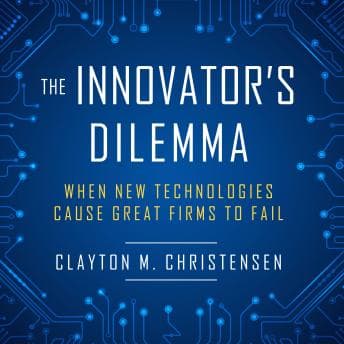
I finally got around to Innovator's Dilemma after referencing "disruptive innovation" in approximately 400 design docs without ever having read the source material. (In my defense, Kevin hadn't read it either, and he's the one who keeps quoting it in product meetings.) I loaded it up during a particularly brutal week where our team was debating whether to sunset a legacy service, and honestly, the timing was almost uncomfortably perfect.
The Original "We Should've Seen This Coming" Framework
Here's what surprised me: this isn't the hand-wavy business philosophy I expected. Christensen builds his argument the way a good engineer builds a proof — methodically, with data. The disk drive industry case study alone takes up a huge chunk of the book, and he uses it to show how companies like Seagate kept optimizing for their existing customers (bigger capacity, faster speeds) while scrappy newcomers built smaller, cheaper drives for markets that didn't even exist yet. He maps out multiple generations of this cycle, and watching the same pattern repeat — 14-inch to 8-inch to 5.25-inch to 3.5-inch — is like watching the same bug reproduce across microservices. You know the fix. The companies knew the fix. They still shipped the bug.
The excavator industry example hit differently too. Christensen traces how hydraulic excavators slowly ate the cable-actuated market from below, starting with small residential jobs that the big players literally didn't want. The incumbents weren't stupid — they were rational. They listened to their best customers, invested in sustaining improvements, and followed every MBA playbook. And that's exactly why they lost. It's the kind of argument that makes you deeply uncomfortable if you work at a large tech company, which — hi, yes, that's me.
Where the 1997 Shows
Okay, but. This book is from 1997, and in audio form, you feel it. Some of the examples — Honda's entry into the North American motorcycle market, the steel minimill disruption — are genuinely fascinating. But others drag because Christensen is meticulous to a fault. He'll restate his framework, apply it to another industry, restate it again. By the third or fourth case study, I was at 1.75x going "yes, Clayton, I get it, the value network constrains the incumbent's response, please move on."
At 8 hours 39 minutes, it's not long by audiobook standards, but it feels longer than it needs to be. This is maybe a 5-hour book stretched by academic thoroughness. I finished it in roughly 4 commutes at my boosted speed, and the middle two were where I had to fight the 6AM zombie brain the hardest.
Also — and I need to flag this — some listeners have reported static/background noise issues with certain versions of this audiobook. I didn't experience anything terrible on my end, but it's worth checking your source. If you're on a rattling Caltrain with mediocre earbuds, any audio quality issue is going to compound fast.
L.J. Ganser Does the Job (But Don't Expect Ray Porter)
Ganser is a solid business book narrator. Clear diction, good pacing, makes the academic prose feel conversational enough. He's not going to make you forget you're listening to a business book — there are no characters to voice, no dramatic tension to build — but he keeps it from becoming a lecture you tune out. He gets to flex that range on Guns at Last Light, where the WWII material actually hands him the drama this book doesn't have. For a book that's essentially "here's my thesis, here are seven case studies proving it," that's the right energy. He's the reliable CI/CD pipeline of narrators: does exactly what you need, nothing flashy, nothing broken.
Who Gets the Most ROI
Perfect for: anyone in tech who's been throwing around "disruption" without reading the source. Product managers, eng leads, anyone who's ever sat in a meeting arguing about whether to invest in the new thing vs. optimize the existing thing. The framework genuinely changes how you evaluate those decisions.
I got a similar reframe from Christensen's follow-up, Competing Against Luck—I actually rated that one a notch higher.Skip for: anyone expecting a modern, punchy business book. This reads like an academic text (because it is one). If you want the TL;DR, you can honestly get 70% of the value from Christensen's original HBR articles and a good summary. And if you're looking for something to follow while half-conscious — this requires more focus than your average narrative nonfiction.
The Commit Message
TL;DR: Worth your commute, but bump the speed. The core framework — why rational, well-managed companies fail by doing exactly what they're supposed to do — is genuinely one of the most useful mental models I've picked up from a business book. The execution is academic and repetitive in spots. But the disk drive genealogy alone is worth the listen, and I've already used the sustaining vs. disruptive innovation distinction three times this week in actual work conversations. The ROI on this audiobook is high if you're in tech, just know you're getting a textbook in audiobook clothing.
Could've been a blog post? No — but it could've been a shorter book.