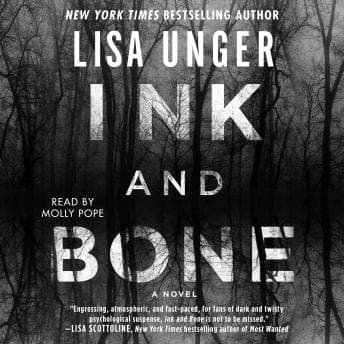
"The Hollows always gets what it wants."
That line hit me around hour eight, and I had to pause the audiobook because Shirley (my cat, not Jackson, though the energy was similar) had just knocked something over in the other room. In the dark. At 1 AM. While I was listening to a story about a town that essentially feeds on psychic energy and missing children.
I listened in the dark. Mistake? Maybe. Worth it? Absolutely.
When Small Towns Have Teeth
Lisa Unger gets something that a lot of supernatural thriller writers miss entirely—the setting isn't just backdrop, it's predator. The Hollows operates like a character with its own hunger, its own agenda. This understands that horror isn't about gore. It's about dread. About the slow realization that the place you've come to for answers might be the thing that's been asking questions all along.
Finley Montgomery is twenty, gifted with precognition she can't control, and frankly kind of a mess. Here's where I need to be honest with you—Molly Pope's interpretation of Finley reads as bratty in places. Some listeners found this grating. I actually think it works? Finley IS immature. She's dealing with powers that would break most people, running from a life she doesn't understand, and she's not handling it gracefully. The petulance in Pope's delivery felt intentional to me, even if it occasionally made me want to shake the character.
The parallel narrative with Merri and Wolf Montgomery—parents in that specific hell of not knowing where their child is, of hope becoming a form of torture—hits different when you're listening at 2 AM. Pope handles Abbey's voice with this fragile quality that got under my skin. The kid feels real. The terror feels real.
The Non-Linear Gamble
Unger plays with timeline here in ways that will either hook you or lose you completely. The story jumps between Finley's journey to The Hollows, the Montgomerys' deteriorating marriage under the weight of grief, and glimpses of what actually happened to Abbey. It's ambitious. It mostly works.
Mostly.
There were moments—especially in the middle hours—where I lost track of when we were. Pope does her best to signal the shifts, but the writing itself doesn't always make the transitions clean. I found myself rewinding a few times, which isn't ideal when you're trying to maintain that creeping tension.
But when it clicks? When all those threads start pulling toward the same dark center? Unger earns the complexity. The reveal isn't just "here's what happened"—it's "here's what this town has been doing all along, and you should have seen it coming."
Pope's Controlled Intensity
Molly Pope delivers this with what I'd call controlled intensity. She's not chewing scenery—the performance stays grounded even when the supernatural elements ramp up. Her Abbey voice genuinely unsettled me. There's this quality to how she reads the child's perspective that feels both innocent and somehow wrong, like she's channeling something the character doesn't fully understand.
The criticism about monotone delivery? I can see it in stretches. There are passages—particularly some of the internal monologue sections—where Pope settles into a rhythm that could lull you if you're not paying attention. This isn't a background listening book. It demands focus, especially through the non-chronological structure.
My podcast listeners are going to love this—it's the kind of audiobook that rewards discussion, that leaves you with questions about what The Hollows actually is, what Finley's powers mean in the larger mythology Unger's building.
Who Gets Lost in These Woods (And Who Should Stay Home)
If you need linear storytelling, skip this. If you want your supernatural elements explained in neat little boxes, this will frustrate you. If you scare easily, maybe don't listen at 2 AM like I did.
But if you want psychological horror that trusts you to keep up, that builds its dread through atmosphere rather than cheap scares, that treats a missing child case with the gravity it deserves while weaving in genuine supernatural menace? This is your book.
It's the fourth in The Hollows series, but I came in cold and followed fine. The town's mythology is woven in naturally—you pick up what you need. That same world-building confidence shows up in Jurassic Park, where Crichton trusts you to follow the science without holding your hand.
Shirley (my cat) was unimpressed. I was terrified. Specifically around hour nine, when certain revelations about Abbey's situation clicked into place and I realized exactly what kind of story Unger had been telling all along.
Horror that respects the genre. Not perfect—the pacing sags in places, Pope's Finley interpretation won't work for everyone, and the timeline jumps occasionally confuse more than illuminate. But when The Hollows sinks its teeth in, you feel it.
Shirley Jackson Walked So Lisa Unger Could Run
This is a solid credit spend if you're a psychological thriller fan who doesn't mind supernatural seasoning. At nearly twelve hours, it's a commitment, but the atmosphere Unger builds—and Pope mostly maintains—makes it worthwhile. Just maybe don't listen alone in the dark.
Or do. I'm not your mother. But The Hollows is the kind of fictional place that stays with you after the audiobook ends.