
I was making dal makhani at 10 PM on a Tuesday — the kind of elaborate cooking project I use to procrastinate on my research papers — when Mike Dooley started yelling at me about how I create my own reality. And I mean that literally. The man narrates his own book with the energy of someone giving a TED talk to a stadium of ten thousand, except I'm alone in my kitchen in Cambridge with lentils simmering and my earbuds in. It's... a lot.
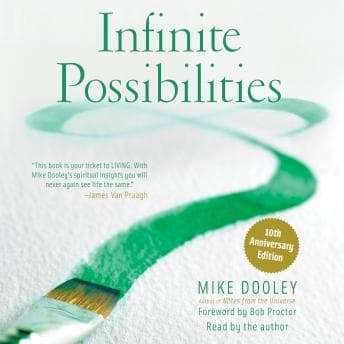
Let me back up. I picked up Infinite Possibilities because I've been on a quiet kick of reading self-help through the lens of narrative psychology — how do these authors construct a story about the self, and does it actually hold up to what we know about human cognition and motivation? The research actually shows that belief in personal agency does correlate with better outcomes, but the mechanism matters enormously. So I was genuinely curious.
When Your Life Coach Won't Use His Inside Voice
Dooley narrates with what I'd call evangelical warmth. He believes every word he's saying, and his voice carries that conviction like a freight train. There's a clarity to his delivery that I appreciated early on — you never miss a word, the production is clean, no weird audio artifacts. But by hour three, I started adjusting the volume down because certain passages felt like he was leaning into the mic with the intensity of a man who just discovered the secret of the universe and needs you to understand it RIGHT NOW.
Compare this to, say, Brené Brown reading her own work, where there's vulnerability in the pauses, the self-deprecating asides. Dooley doesn't do vulnerability. He does certainty. And look, for some people that's exactly what they need — someone who sounds absolutely sure that you can manifest your dream life through belief and expectation. The self-confidence mechanics are genuinely interesting to compare across genres — I was thinking about this recently while reading 100 Ways to Overcome Shyness, which takes a much quieter, more incremental approach to building belief in yourself and lands closer to what my nervous system actually wants. But if you're someone who processes ideas better with a calmer delivery (hi, me, a person whose therapist specifically talks about nervous system regulation), you might find yourself taking breaks.
I'd honestly recommend 1.25x speed, which paradoxically smooths out some of the intensity by reducing the dramatic pauses between his Big Statements.
The Belief Engine vs. The Evidence Base
Here's where it gets psychologically interesting. Dooley's central framework — that thoughts become things, that we are the architects of our reality — is a classic internal locus of control model dressed up in spiritual language. And I found myself asking: why does this framework appeal so deeply to millions of people? Because it does something powerful. It takes the terrifying randomness of existence and hands you a steering wheel.
The first chunk of the book leans heavily into what some listeners have called pseudo-religious territory. Dooley talks about "divine intelligence" and our "true spiritual nature" with the confidence of someone who's never had a crisis of epistemology. If you come from a scientific or even skeptical background, this section will test your patience. I nearly bailed around the equivalent of what other listeners described as the first 25 pages — it felt less like psychology and more like cosmology without the peer review.
But. And this is important. If you push past that opening, Dooley gets more practical and more interesting. He shifts into discussions about visualization, expectation, and the mechanics of how beliefs shape behavior. Stripped of the spiritual packaging, some of this genuinely tracks with what we know about self-fulfilling prophecies and expectancy effects in psychology. The research on mental rehearsal in athletes, for instance, supports parts of what he's describing — just not the metaphysical wrapper.
The 10th anniversary additions — Bob Proctor's foreword and Dooley's new introduction — are fine. They're fan service for the already converted. They didn't change my experience meaningfully.
Who This Is Really For (Be Honest With Yourself)
This is a fascinating case study in the self-help genre's central tension: inspiration vs. information. Dooley is heavy on the former, light on the latter. If you want someone to make you feel like you can change your life through sheer force of positive expectation, he's your guy. If you want mechanisms, evidence, action plans — look elsewhere. This isn't a workbook. It's a worldview.
Best for: people in transition who need a shot of agency and hope. Commuters who want motivational energy. Fans of Abraham Hicks or The Secret who want a more articulate version of that philosophy.
Skip if: you're allergic to Law of Attraction frameworks, you need practical step-by-step guidance, or you're noise-sensitive and don't want someone shouting affirmations into your prefrontal cortex.
At nearly 11 hours, it's a significant time commitment for a book that could've been tighter at seven. The middle sections repeat core ideas with different metaphors, which is either reinforcing or redundant depending on your tolerance.
My Therapist Would Have Thoughts
I didn't hate this book. I didn't love it either. Psychologically, parts of it don't track — the idea that negative outcomes are always the result of misaligned thoughts is genuinely dangerous territory when applied to people dealing with systemic oppression, illness, or trauma. Dooley doesn't adequately address this, and that's a significant blind spot.
But I kept listening. Through the dal, through the dishes, through a morning jog where Dooley told me I was an eternal being having a human experience and I thought, "Sure, Mike, but my knees hurt." There's something about his earnestness that's hard to fully dismiss. He believes it. And belief — even imperfect, even unscientific — is a powerful psychological force.
The protagonist of this book is you. And Dooley really, really wants you to have a happy ending. Whether you buy his method of getting there is between you and your epistemology.