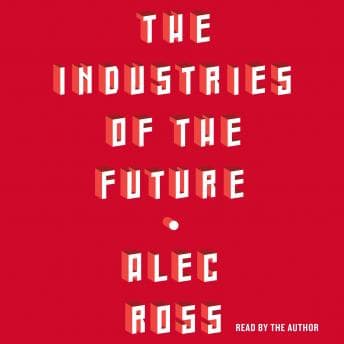

"The next arms race won't be about who has the most aircraft carriers." Ross drops that line early on, and it stuck with me because I've spent the better part of my career watching exactly that shift happen in real time. I was driving back from a client meeting in San Marcos - corporate campus security assessment, the kind of bread-and-butter work that keeps the lights on - and Ross was walking me through how Estonia basically rebuilt its entire government digitally after a massive Russian cyberattack in 2007. That's the kind of real-world case study that grabs me by the collar.
Let me cut to the chase: this is a solid primer on where the global economy is headed, but it's showing its age, and the audiobook production has some genuine problems.
A Policy Wonk's World Tour, Not a Tech Bro's TED Talk
What separates Ross from the typical Silicon Valley futurist is his State Department lens. The guy traveled to 41 countries as Hillary Clinton's Senior Advisor for Innovation, and it shows. He's not just talking about robotics and AI from a San Francisco bubble - he's connecting genomics commercialization to how Rwanda is leapfrogging traditional banking infrastructure, or how South Korea's R&D labs are approaching robotics differently than Japanese firms. The chapter on cybersecurity had me nodding along because I've briefed corporate boards on these exact threat vectors. Ross gets the geopolitical dimension right: he understands that innovation doesn't happen in a vacuum, it happens within power structures.
The book covers five major sectors - robotics, genomics, cyber, big data, and the future of money and markets - then pivots to what these mean for work, governance, and the next generation. It's ambitious for under nine hours. Sometimes too ambitious. The genomics chapter felt like it wanted to be its own book, rushing through CRISPR implications and precision medicine without giving either enough room to breathe. But the cybersecurity section? The author clearly did their homework. His discussion of how nation-states weaponize code reads like an intelligence briefing, not a pop-science overview.
Where the Recording Falls Apart
Here's where I have to be honest. Ross narrates his own book, and his delivery is clear and conversational - he sounds like a smart guy explaining things over dinner, which works for this material. No pretension, no dramatic pauses. But the recording quality is genuinely rough in spots. There's audible stuttering - not Ross stumbling over words, but actual production artifacts, like someone didn't clean up the edit points. I noticed it first around the transition between the robotics and cyber chapters. Ranger lifted his head from the back seat, and when my dog notices audio problems, that's saying something.
At 1.25x, Ross's natural speaking pace becomes brisk but manageable. He's not a trained narrator, so there's a flatness to extended passages that a professional voice actor would've handled better. But there's an authenticity trade-off: when he's recounting a conversation with a Kenyan entrepreneur or describing what he saw in a South Korean lab, you believe him because he was actually there.
The 2016 Problem
This is where it lost me at times. The book was published in 2016, and the technology landscape has moved fast. His AI predictions are interesting to hear now - some were prescient, others already feel quaint. He talks about Bitcoin and digital currencies in terms that feel like ancient history post-2021. That's nobody's fault; it's just the shelf life of tech-forward books. What holds up better are his observations about the structural factors - how nations build innovation ecosystems, why some countries produce startups and others don't. The framework is more durable than the specific predictions.
Ross also has a habit I recognize from briefing rooms: he name-drops. Google founders, Twitter founders, David Petraeus (a name I have complicated feelings about, like most Army officers of my generation). Sometimes the name serves the argument. Sometimes it just feels like credential-polishing. I noticed something similar reading Short Life of Abraham Lincoln - a book that also walks the line between genuine insight and the author leaning hard on proximity to greatness as a substitute for argument.
Who Should Deploy With This Book
If you're looking for a broad-spectrum scan of technology's impact on geopolitics and economics - and you can forgive some dated specifics - this is worth your time. It's particularly good for people who aren't tech-native but need to understand the landscape. Half my clients are executives who still think cybersecurity is an IT problem. I'd hand them this book.
If you want deep technical analysis on any single topic, this isn't it. And if audio quality bothers you - if you're the type who notices a bad edit the way I notice someone calling an M4 an "assault rifle" - the production issues will grate on you.
Mission Debrief
Worth your time? Here's the debrief: good intel, decent delivery, mediocre production. Ross thinks like a strategist, not a technologist, and that's actually his strength. I've seen this scenario play out in real life - the best briefings come from people who understand the human systems around the technology, not just the tech itself. Read this for the geopolitical framing, not the specific predictions. And maybe grab the print version if audio quality is a dealbreaker for you. Ranger gave it a solid ear-perk but fell asleep during the genomics chapter. Fair assessment.




![Steve Jobs [unabridged audiobook] audiobook cover](/_next/image?url=https%3A%2F%2Fcovers.audiobooks.com%2Fimages%2Fcovers%2Ffull%2F9788499923406.jpg&w=1920&q=75)