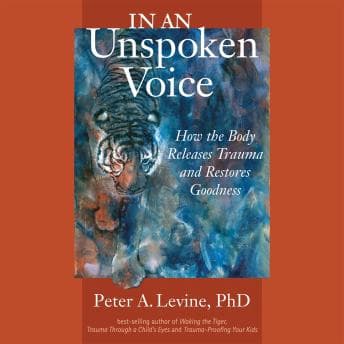

Everyone keeps telling me Peter Levine's In an Unspoken Voice is the definitive text on somatic trauma work. Therapist friends swear by it. It's translated into 17 languages. Gabor Maté wrote the introduction. So I went in expecting to be impressed. And the content? It delivered. The audiobook experience? That's where we need to talk.
I was up late reorganizing my home office — Jenny's been on me about the "paper situation" for weeks — and figured 12 hours of trauma science would pair well with filing old client engagement letters. What I didn't expect was to stop filing entirely around the two-hour mark, sitting on the floor surrounded by manila folders, genuinely rethinking how I understand stress responses in the founders I coach.
The Smartest Framework Nobody in Business Is Using
Here's what got me: Levine's core argument is that trauma isn't a psychological disorder — it's an incomplete physiological response. Your body got stuck mid-survival-instinct and never finished the cycle. He draws on animal behavior to make the point — a gazelle that escapes a lion literally shakes off the stress response and walks away fine. Humans? We override that instinct with our big rational brains and then wonder why we're broken.
The case studies hit different when you've spent years in consulting watching executives make inexplicable decisions under pressure. Levine describes working with a patient named Nancy who experienced a full-body freeze response during a routine medical procedure — her body essentially replayed an old trauma pattern without her conscious mind understanding why. The clinical detail here is granular. He walks through the autonomic nervous system's role, the interplay between the reptilian brain and the neocortex, the difference between healthy mobilization and maladaptive freezing. This is what my parents did instinctively — my mom would physically shake her hands after a confrontation with a difficult customer, a little Korean ajumma ritual I always thought was theatrical. Turns out she was completing a stress cycle before Levine gave it a name and a TED talk.
The key takeaway is worth the listen. The other 7 hours? Actually, no — this is one of those rare cases where most of the 12 hours earns its runtime. The neuroscience sections, the body-awareness exercises, the clinical vignettes — they build on each other. Levine connects Darwin's observations on emotional expression in animals to modern polyvagal theory, and somehow makes it accessible without dumbing it down. I've read (listened to) maybe 30 books in the self-help/psychology space this year. Most of them are recycling two good ideas. This one has legitimate intellectual depth.
Ed Nash and the Pronunciation Problem
So here's where I get honest, and Jenny would say I'm being harsh. Jenny is right. But also — I'm right.
Ed Nash narrates clearly. His voice is fine. Pleasant even. But he sounds like a competent audiobook narrator who was handed a manuscript full of specialized terminology he'd never encountered before, and nobody in the production chain bothered to coach him or — critically — edit the takes. When you're discussing concepts like "proprioception" and "interoception" and "Somatic Experiencing" as a branded methodology, you need a narrator who can say these words like they understand them, not like they're reading them off a teleprompter for the first time. There are moments where the cadence just... breaks. He'll emphasize the wrong syllable in a technical term, or plow through a passage about the vagus nerve with the same emotional register as reading a grocery list.
At 2.0x this was rough. I actually had to drop to 1.5x for the denser neuroscience chapters because Nash's pacing didn't give me enough space to process the material when sped up. That's a first for me this year.
The production itself is clean — no weird background noise, no obvious splices — but the lack of editorial polish is real. This is a book that deserved either Levine himself narrating (he's got the warmth and expertise) or a narrator who spent serious time with the material beforehand. What we got was... adequate. And adequate isn't good enough for a 12-hour commitment on content this important.
Who Gets the ROI Here
If you're a therapist, coach, or anyone working with people under chronic stress — this is essential reading. The framework alone justifies the time. If you've read Waking the Tiger and want the full scientific architecture behind Levine's approach, this is the upgrade.
But if you're narration-sensitive, or if mispronounced terminology is going to pull you out of the material every 20 minutes, buy the print book instead. Seriously. The ideas are too good to let a mediocre audio production get in the way.
If you're a founder or exec who's been told to "just manage your stress better" by some executive coach charging $500 an hour — skip the coach, listen to chapters 1 through 4, and understand why your body keeps betraying your brain in high-stakes moments. That alone is worth more than most leadership books on the market.
The Dry Cleaning Test
My parents never had language for what happened to their bodies during the LA riots in '92. They just worked harder. Levine's book is the vocabulary for what people like them — people who survived real things and kept moving — carry in their nervous systems for decades. It's not self-help fluff. It's not "just breathe" Instagram wisdom. It's rigorous, compassionate science about why the body keeps score (yes, van der Kolk's phrase, but Levine was doing this work in parallel). The parenting application of this same nervous-system thinking actually gets a more accessible treatment in Raising Good Humans — lighter on the science, but it's where I'd send someone who found Levine's clinical depth a barrier to entry.
Bottom line: brilliant content, frustrating narration. Get the knowledge into your brain however you can — but if audio is your only option, slow it down, be patient with Nash, and focus on what Levine is actually saying. The ideas will outlast the delivery.