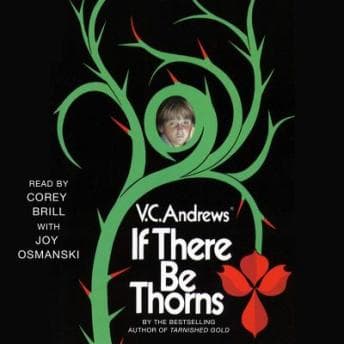
Look, I need to talk about Bart Sheffield-Dollanganger, because this kid made me want to reach through my headphones and shake somebody. Not him, specifically - he's nine, and V.C. Andrews writes his descent into something genuinely unsettling with the kind of precision that makes you uncomfortable in your own skin. No, I wanted to shake every adult in this book who watches this child spiral and just... wrings their hands about it. Which, honestly? That's the point. That's always been the point with this family.
I was reorganizing the horror section at the library - yes, we have one, and yes, I've arranged it by vibes rather than strict alphabetical, fight me - when Bart started narrating his journal entries. And I had to stop shelving because Corey Brill does something with Bart's voice that genuinely unsettled me. There's this creeping shift from lonely kid who talks to his imaginary friends to something colder, something that mimics his grandfather Malcolm's rigid cruelty. Brill doesn't just flip a switch. He layers it. Each chapter from Bart's perspective gets a little more clipped, a little more archaic in cadence, like a child playing dress-up in a dead man's ideology. It's subtle work, and it commits to the horror of watching innocence curdle.
The Rot Grows From the Root
If There Be Thorns is the third Dollanganger book, and by now, Andrews has built a family saga that runs on a very specific fuel: secrets that everyone keeps "for the children" that end up destroying the children anyway. Cathy and Chris - yes, THAT Cathy and Chris, with THAT secret - have built what looks like a normal life. Jory is the golden child, the dancer, the one who got his mother's grace. Bart is the other one. The clumsy one. The weird one. The one nobody quite knows what to do with.
And then the Old Woman in Black moves next door.
Andrews understood something about horror that a lot of writers miss: the scariest thing isn't the monster. It's watching someone you love become one. The Vanishing Half gets at something similar - the horror of watching a family member reshape themselves into someone unrecognizable, and the quiet devastation of those left trying to make sense of who's actually gone. Bart doesn't get possessed or cursed. He gets love-bombed by his grandmother Corrine - who is, let's be clear, trying to buy absolution with cookies and ice cream and a mansion full of guilt. She hands him Malcolm's journal, and this already-fragile kid starts modeling himself after a religious zealot who locked children in attics. Shirley Jackson walked so V.C. Andrews could sprint directly into the most disturbing corners of family dysfunction.
The dual narration between Jory and Bart is where this audiobook earns its keep. Joy Osmanski handles Jory's chapters with this earnest, slightly bewildered quality - he's a teenager watching his brother fall apart and trying to make sense of parents who clearly have secrets. Brill's Bart, meanwhile, starts fracturing. The journal entries where Bart channels Malcolm are genuinely creepy. There's this one stretch where Bart's narration shifts mid-paragraph from a scared little boy to this imperious, punishing voice, and Brill nails the transition without overselling it. The narrator commits. That's rare.
Eleven Hours of Family Secrets Eating Themselves Alive
Here's my issue, and I say this as someone who has consumed the entire Dollanganger saga like it's my job (it kind of is - podcast episode dropping next month): the pacing in the middle section sags. Andrews repeats the same emotional beats - Cathy worries, Chris deflects, Bart acts out, everyone is shocked - in cycles that feel circular rather than escalating. Around hour six, I found myself wishing someone would just DO something instead of monologuing about their feelings for the fortieth time. The 1970s gothic soap opera energy is part of the charm, sure, but at eleven hours, you feel every minute of the slower stretches.
And the content warnings are real. Violence toward animals, child abuse (psychological and physical), the ongoing incestuous relationship between Cathy and Chris that the book treats as romantic - if you're coming to this series fresh, know what you're walking into. Andrews doesn't flinch from the darkness, and neither do the narrators. Whether that's a feature or a bug depends entirely on your tolerance.
But when it works? It WORKS. The final act is Andrews at her gothic best - a fire, a confrontation, family sins literally and figuratively burning everything down. I listened to the last hour in the dark at my apartment, Shirley (my cat) curled up on the back of the couch, and even she seemed tense. She was probably just annoyed I hadn't fed her. But I'm choosing to believe she felt it too.
Who Needs This (And Who Should Run)
If you've been following the Dollanganger series, this is essential. It answers questions from the first two books while planting new thorns (pun intended, no apologies) for the next. If you haven't read Flowers in the Attic or Petals on the Wind, do NOT start here. You'll be lost, and worse, the emotional weight won't land.
If you scare easily - not in the jump-scare sense, but in the "watching a family destroy itself in slow motion" sense - skip. If you don't? You need this. Finally, horror that respects the genre, even when that genre is dressed up as a family drama.
My Podcast Listeners Are Going to Have Opinions
This isn't perfect. The pacing stumbles, the repetition tests your patience, and some of the dialogue is peak 1980s melodrama in ways that haven't aged gracefully. But Brill and Osmanski elevate the material, and Andrews' understanding of how inherited trauma twists children into mirrors of the people who hurt them? That's real horror. That's the kind that follows you after you turn the lights back on.