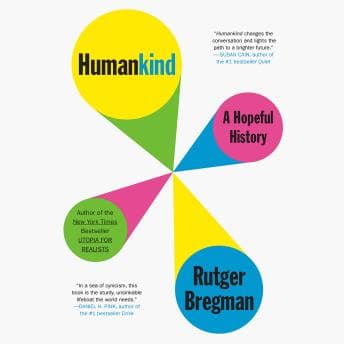

So everyone keeps calling this "the Sapiens of 2020" and honestly? That comparison both helps and hurts it. I started this one not on Caltrain but during a 2AM insomnia spiral after a particularly demoralizing on-call shift where three different services decided to cascade-fail simultaneously. I was lying in bed thinking about how every human who touched that system had made the worst possible decision at every juncture, and then Bregman opens with this thesis that actually, no, humans are fundamentally decent. The timing was... therapeutic.
The Core Argument Is Basically a Git Revert on Western Philosophy
TL;DR: Worth your commute. Bregman's thesis is that the "veneer theory" of civilization - the idea that we're all savage beasts barely held in check by institutions - is wrong, and he's got receipts. This is basically Sapiens but for optimists who want to believe their coworkers aren't secretly sociopaths.
The book systematically dismantles some of the most famous "proof" that humans are terrible. The Stanford prison experiment? Bregman digs into the archives and shows Zimbardo was basically directing his guards to be cruel - it wasn't spontaneous darkness bubbling up from human nature, it was a badly designed experiment with a researcher who had his thumb on the scale. The Milgram shock experiments? Similar issues with methodology and selective reporting. The Kitty Genovese "38 witnesses who did nothing" story that launched an entire field of bystander effect research? Turns out the original reporting was wildly inaccurate, and people actually did try to help.
But my favorite section - the one that genuinely made me sit up at 3AM - is the real-life Lord of the Flies. In 1965, six Tongan schoolboys actually got shipwrecked on a deserted island for over a year. And instead of descending into William Golding's nightmare, they cooperated, set up a garden, built a gym, kept a signal fire burning, and even set and splinted a broken leg. When one kid got into a fight with another, the group's rule was that the two boys had to go to opposite ends of the island to cool off, then come back and apologize. Teenagers. On a desert island. Being more emotionally mature than half the adults in my Slack channels.
Where the Optimism Gets a Little Too Optimistic
Here's where I started pushing back. Bregman is a gifted arguer, but he occasionally does this thing where he cherry-picks the debunking studies while not fully interrogating his own counter-evidence. Like, okay, the Stanford prison experiment was flawed. Agreed. But that doesn't automatically prove humans are angels - it proves that one experiment was bad science. The logical leap from "famous studies about human cruelty had methodological problems" to "humans are fundamentally good" is... bigger than he sometimes acknowledges.
He's also working with a pretty specific definition of "human nature" that conveniently brackets out a lot of history. The book covers the Blitz and how Londoners showed solidarity under bombing, which is true and moving. But the people doing the bombing were also humans. Bregman addresses this - his framework for explaining human cruelty involves loyalty to in-groups and dehumanization of out-groups - but it felt like the weakest part of the argument, kind of hand-wavy compared to the surgical precision of his earlier debunking chapters.
Still, I'd say the ROI on this audiobook is high. Even when I disagreed, I was actively thinking, which is more than I can say for most pop science books that could've been a blog post. This one earns its 11+ hours.
The Dual Narrator Situation
So Bregman narrates alongside Thomas Judd, and this is where I have to be honest about a gap - the research doesn't have much detail on how they split duties. Based on my listen, Bregman brings that Dutch-accented enthusiasm of someone who genuinely believes what he's saying (because he wrote it), and there's an energy to author-narrated nonfiction that a hired voice can't quite replicate. But his delivery is more "charismatic professor giving a lecture" than "seasoned audiobook narrator," which means the pacing occasionally feels uneven. Judd smooths things out. It works. It's not Ray Porter (nothing is), but it works.
Perfect for: train, gym. Skip for: bedtime - this one will get your brain arguing with itself when you should be sleeping. Ask me how I know.
Who This Is Actually For (and Who Should Skip)
If you liked Sapiens, Factfulness by Hans Rosling, or Bregman's own Utopia for Realists, this is a no-brainer. If you're a cynical engineer who's spent too long reading incident reports and assumes everyone is an idiot - hi, it's me - this is genuinely refreshing without being naive. I finished this in about 5 commutes at 1.5x and came away with a slightly better opinion of the species. Edward Snowden's Permanent Record gave me a similar gut-check moment about institutional trust versus individual conscience — also very commute-friendly, also the kind of thing that makes you stare out the Caltrain window thinking harder than you planned to.
Skip if you want rigorous academic treatment. This is popular history with a thesis to prove, and it reads like it. Bregman is a journalist and storyteller first, and sometimes the argument sacrifices depth for narrative momentum. If that bugs you, read the footnotes (or, you know, the actual studies he cites).
Kevin said he could tell I was listening to something optimistic because I stopped complaining about our neighbors for a whole week. I told him correlation isn't causation. He said that proved Bregman's point about humans being difficult on purpose. Touché.