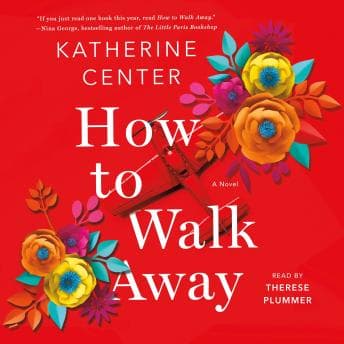

What happens when the girl who did everything right — the planner, the optimizer, the one with the five-year spreadsheet — has her entire life ripped away in a single moment?
I'll tell you what happens. You sit in your minivan in the garage at 10 PM, mascara from this morning still barely hanging on, and you ugly-cry into a travel mug of reheated coffee. That's what happens. Thanks, Katherine Center.
The One Where the Spreadsheet Burns
So here's the setup: Margaret Jacobsen has it all lined up. Dream job. Hot fiancé. A proposal that's basically Instagram-ready. And then a small plane crash — because OF COURSE it's a small plane crash — obliterates everything. She wakes up in a hospital bed, possibly paralyzed, and her fiancé Chip is somehow making HER catastrophic injury about himself. If you've ever had a partner who responded to your crisis with "but what about MY feelings," you will want to throw your phone across the room during these scenes. I actually gripped my steering wheel so hard during one of Chip's self-pity monologues that my knuckles went white.
But here's what makes this more than just a "woman overcomes adversity" story. Center nails the specific, humiliating indignities of losing your body's cooperation. Margaret can't shower alone. She has to relearn things toddlers can do. And I kept thinking about Sophie learning to walk last year — the wobbling, the falling, the fury — and realizing that Margaret is going through that same primal frustration but with the added horror of knowing exactly what she's lost. That parallel wrecked me.
Then there's Kit, Margaret's sister, who ghosted the entire family for three years and picks NOW to show back up. The sister dynamic is where Center really shines compared to her other books. In Things You Save in a Fire she did the workplace-family-of-choice thing well, but the Kit-Margaret relationship here has this messy, specific tension — Kit did something genuinely terrible, and the book doesn't let her off easy for it. It also doesn't make Margaret a saint about it. They're both wrong in different ways. As someone whose sister called me "the boring one" at Thanksgiving 2019 and yes I'm still thinking about it, this hit differently. That same messy, neither-of-you-is-entirely-innocent sister energy runs through Truth About Melody Browne too, and it wrecked me in a completely different way — highly recommend if you want to ruin another evening in your car.
Ian and That Accent (Lord Help Me)
Okay, Ian. The grumpy Scottish physical therapist who pushes Margaret harder than she wants to be pushed. Is it predictable that she falls for him? Yes. Did I care? Not even a little. Because Thérèse Plummer gives Ian this Scottish accent that starts out clipped and sharp — he's all business, borderline cold — and then these tiny moments of warmth crack through and you can HEAR it in his voice before Margaret even registers it. The scene where Margaret imagines walking again and Ian's just... quietly there? Plummer drops his voice to something softer and I had to sit in the school pickup line pretending I had allergies.
Plummer is genuinely great here. She keeps Margaret's voice distinct — a little type-A, a little breathless, increasingly raw as the story goes on — without ever making her sound whiny, which would've been so easy to do with a character who's processing this much grief. The emotional beats land clean even at 1.25x speed.
Is the story predictable after the first few chapters? Yeah, kind of. You can see where it's going. But here's my take: predictable isn't the same as boring. I knew the yogurt was going to end up on the floor when Sophie grabbed the spoon, but watching it happen was still an experience. Center's strength isn't the surprise — it's the texture. The small moments. The bonus story from the rescue firefighter's perspective is a nice touch that adds dimension you weren't expecting.
Some people have complained that Margaret's problems resolve too neatly, and... fair. There are moments where the emotional recovery outpaces what feels realistic. The family reconciliation with Kit wraps up faster than I'd buy in real life. But honestly? After the gut-punch of the first half, I was grateful for a satisfying ending. Exactly what I needed.
Car Time Approved (With a Tissue Warning)
I finished this in about a week — nap times, drop-offs, and three glorious garage-sitting sessions. It survived approximately 47 pauses (conservative estimate, Sophie found the dog's water bowl twice during Chapter 12) and I never lost the thread. At 11 and a half hours it's not a quick listen, but it moves. You won't be checking how much time is left.
Who should grab this: Anyone who likes Katherine Center, anyone who needs a good cry followed by a good sigh, anyone whose comfort zone is "woman rebuilds her life and also there's a hot guy." Not groundbreaking, but sometimes you don't need groundbreaking. Sometimes you need to feel something real while sitting in your car avoiding bedtime routine.
Who should skip: If you need plot twists to stay engaged, or if medical/recovery storylines trigger anxiety, this might not be your book. And if predictable romance makes you twitchy, you'll see the ending coming from hour two.
Made me cry at school pickup. Worth it though.