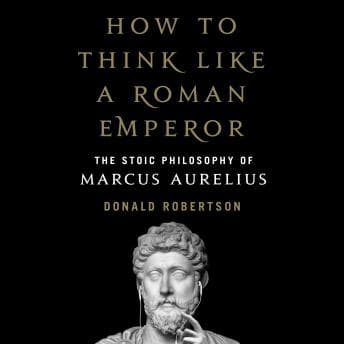

What happens when a psychotherapist writes about a philosopher-king, and then reads his own book aloud to you? Honestly, I wasn't sure what to expect. But here's the thing—Robertson isn't just summarizing Stoicism. He's doing something way more interesting. He's treating Marcus Aurelius like a case study.
And as someone who literally does this for a living (analyzing fictional characters, but still), I was immediately hooked.
The Emperor on the Couch
Robertson weaves Marcus's biography with cognitive-behavioral therapy techniques, and the result is surprisingly intimate. We're not getting the sanitized marble-bust version of the emperor. We get the anxious young man, the grieving father who lost multiple children, the leader dealing with plague and war and his own mortality. Classic patterns of someone actively working on themselves—not arriving at wisdom, but struggling toward it.
What makes Marcus compelling here is that Robertson doesn't pretend he had it figured out. The Stoic practices weren't magic. They were tools. Daily, imperfect tools. My therapist would have thoughts about this character, and I mean that as the highest compliment.
The research actually shows that ancient Stoic techniques overlap significantly with modern CBT—something Robertson, as a practicing therapist, is uniquely positioned to explain. He doesn't just tell you what Marcus believed. He shows you how those beliefs functioned psychologically. Why distancing yourself from your emotions (the famous "view from above") actually works. Why naming your cognitive distortions matters.
I found myself asking: why does this two-thousand-year-old philosophy feel so relevant? Robertson has an answer. It's because the human mind hasn't changed. We still catastrophize. We still fear what we can't control. We still need someone to remind us that our judgments—not events—cause our suffering.
When the Author Becomes the Voice
Okay, so Robertson narrates his own book. This is always a gamble. Some authors should never be allowed near a microphone. (Don't tell my students I said that.) But Robertson? He's calm, clear, and genuinely soothing. There's something fitting about a therapist's voice guiding you through emotional resilience techniques.
His delivery isn't dramatic. It's not trying to be. It's more like... a really good lecture from a professor who actually cares whether you understand. The storytelling sections flow naturally, and when he shifts into first-person narratives—imagining Marcus's inner voice—there's real emotional weight there. One listener mentioned crying during these sections, and I get it. The vulnerability lands.
The one critique I've seen is that the editing feels slightly rushed in places. I noticed a few transitions that felt abrupt, like someone was in a hurry during post-production. It's not a dealbreaker, but if you're sensitive to pacing issues, it might pull you out occasionally.
Who Should Listen (And Who Should Skip)
Best for: morning commutes, long walks, any activity where you want to feel like you're doing something productive for your mental health. I listened during my Cambridge jogs and found myself pausing to actually think—which, honestly, is rare. Most audiobooks I can zone through. This one demanded engagement.
If you've bounced off Meditations because Marcus's journal entries felt cryptic or disconnected, this provides the context you were missing. Robertson respects his audience's intelligence while still meeting you where you are.
Skip if: you want fast-paced entertainment or you're already deep into Stoic literature. This is introductory, comprehensive, and thorough. If you've read Ryan Holiday's books and want something with more psychological depth, this is your next step. For a completely different approach to self-improvement—one that's honestly less grounded but weirdly compelling—I analyzed 7 Eternal Laws of Success recently. If you've already studied Epictetus extensively, you might find some sections review.
Also—and I say this with love—if you're the type who needs to highlight and annotate, you might want the print version too. Several listeners mentioned buying both, and I understand why. There's enough richness here that you'll want to return to specific sections.
Over Morning Coffee
Robertson understands human nature. That's the simple version. He gets that Marcus Aurelius wasn't a saint or a superhuman—he was someone who practiced. Who failed. Who kept practicing anyway.
Psychologically, this tracks. And that's the highest praise I can give a self-help book. It doesn't promise transformation. It offers tools and shows you someone who used them imperfectly, across a lifetime, during circumstances most of us can't imagine.
Would I listen again? Parts of it, absolutely. The sections on dealing with anger and pain are genuinely useful—not in a vague inspirational way, but in a "here's what to actually do" way. That's rare.
My one wish? That the production had been given a bit more breathing room. But the content itself? Solid. Really solid.