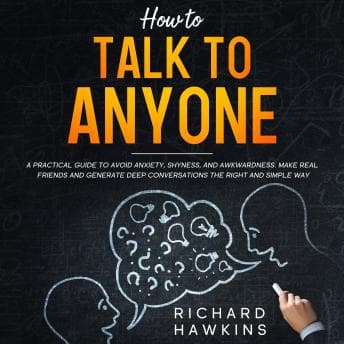

How many self-help books have promised to fix your awkward small talk, only to leave you with generic advice you could've Googled in five minutes?
I started this one during a particularly brutal Monday morning commute—you know, the kind where you're sardined between someone's backpack and another person's aggressive cologne, desperately trying to avoid eye contact with everyone. Seemed fitting for a book about talking to people, right?
The Blog Post Problem
Let me be real with you: this is a 71-minute audiobook. That's not even one full commute for me. And honestly? It feels like exactly what it is—a blog post stretched into book form. Richard Hawkins covers the basics: active listening, assertiveness, conflict resolution, reading body language. All solid topics. All things you've probably encountered in a dozen LinkedIn articles.
The content isn't wrong—it's just not deep. You get surface-level frameworks without the psychological research to back them up, without the case studies that make concepts stick. It's like someone handed you a recipe that says "add spices" without telling you which ones or how much. Technically accurate, practically useless.
Orlena Cain Does Her Job
The narration is... fine? Orlena Cain has clear enunciation, consistent pacing, and she doesn't stumble over anything. For a straightforward self-help book, that's really all you need. No character differentiation required here—just one voice delivering advice. She sounds professional, maybe a little like a corporate training video, but not in a way that grates on you.
I bumped it to 1.75x (my standard for business books that could've been blog posts) and it worked perfectly. At normal speed, the pacing would feel sluggish.
Who This Actually Helps (And Who Should Skip)
Here's the thing—if you're someone who's never thought critically about communication before, this might genuinely help. Complete beginners to the self-improvement space might find value in having these concepts organized and presented verbally. Sometimes hearing advice out loud hits differently than reading it.
But if you've read any other communication book—Leil Lowndes' "How to Talk to Anyone" (the more famous one), "Crucial Conversations," "Never Split the Difference"—you're going to be bored. Skip this. If you're looking for something with actual depth on navigating social anxiety, Never Chase Men Again at least attempts to dig into the psychology behind our behavior patterns, even if it's focused on dating specifically.
The subtitle promises to help you "avoid anxiety, shyness, and awkwardness," but there's no real psychological depth on why we feel these things or how to rewire those patterns. It's more like a checklist of behaviors to adopt rather than a genuine understanding of social dynamics.
The ROI Calculation
At 71 minutes, the time investment is minimal. But that's also kind of the problem—you're not getting enough depth to actually change behavior. Real skill-building requires repetition, examples, practice scenarios. This feels like a trailer for a book rather than the book itself.
If this were a free podcast episode, I'd say "sure, throw it on." As something you're spending a credit on? The math doesn't work. That same credit could get you a 15-hour deep dive into negotiation psychology or a comprehensive communication framework with actual case studies.
End of Line
I finished this before I even got to Palo Alto. Didn't have to rewind anything, didn't miss concepts while zoning out at 6 AM—which tells you something about the complexity level. It's perfectly adequate background listening if you're doing something else, but it's not going to stick with you.
Kevin asked me what I learned from it when I got home, and I genuinely struggled to come up with anything I hadn't heard before. "Be an active listener. Be assertive but calm. Read the room." Cool. Thanks.
For the socially anxious engineer who's never cracked a self-help book—maybe start here as training wheels, then graduate to something more substantial. For everyone else? Your commute time is worth more than this.