
"Your subconscious mind is a powerful ally—or your worst enemy."
Somewhere around the two-hour mark, that line hit me while I was reorganizing my home office at midnight. Jenny was asleep, I was caffeinated, and I realized I'd been listening to something that had nothing to do with the title I'd downloaded.
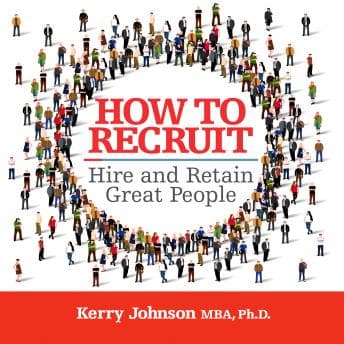
Let me explain. You click on *How to Recruit, Hire and Retain Great People* by Kerry Johnson expecting—reasonably—a book about recruiting, hiring, and retaining great people. What you get instead is Claude Bristol's 1940s mindset philosophy wrapped in confusing packaging. The description literally pivots mid-paragraph from hiring to "blasting obstacles" and "projecting confidence." I've seen some creative product bundling in my consulting days, but this is next level.
The Bait-and-Switch Problem
Here's what happened: This appears to be Bristol's *The Magic of Believing* and *T.N.T.: It Rocks the Earth* repackaged under Kerry Johnson's name with a completely misleading title. Johnson is a legitimate business psychologist—Harvard, Oxford, the whole resume—but the content here is vintage Bristol. And look, Bristol's work has merit. My parents never read *The Magic of Believing*, but they lived it every day pressing shirts in Koreatown. The "power of focused intention" isn't woo-woo when you've watched someone build a business through sheer will.
But if you're a startup founder or HR director who grabbed this expecting tactical frameworks for talent acquisition? You're going to be very confused when Bristol starts talking about the subconscious mind and mental suggestion techniques from 1948.
What 6.5 Hours Actually Delivers
Tim Andres Pabon delivers the narration in a steady, professional tone. Nothing remarkable, nothing offensive. He reads like a competent corporate trainer—clear enunciation, measured pacing. At 2.0x, it flows fine. The production is clean, no audio artifacts or weird editing jumps.
The content itself? Classic mid-century success literature. Bristol covers visualization techniques, the importance of appearance and first impressions, transferring thoughts to others (yes, that's how he phrases it), and building unshakeable confidence. Some of this has aged well—the stuff about focused aims and consistent action could slide into any modern goal-setting book. Other parts feel like your grandfather's self-help, complete with references to "the mental secret" that sounds vaguely mystical.
I've seen these principles work in practice. The CEO who visualizes the acquisition before negotiations. The founder who projects certainty even when the runway is three months. Dare to Lead tackles that same projection of confidence, but grounds it in actual vulnerability and team dynamics rather than mental mysticism. I've also seen this thinking become dangerous—the "just believe harder" crowd who ignore market signals because their subconscious is supposedly handling it. Essentialism offers a sharper antidote to that delusion—it's about cutting through the noise instead of manifesting your way around it.
Who Should Hit Play (And Who Should Run)
If you want Bristol's original work and don't mind the weird packaging, this delivers. It's a decent audiobook version of classic success literature. Skip this entirely if you actually need help with recruiting and retention—try LinkedIn Learning instead. Or better yet, call me. I've watched three different companies fail at this, and none of them needed more visualization.
The 6.5-hour runtime is reasonable for what's essentially two books combined. But the value proposition is murky at best. You're not getting Kerry Johnson's business psychology expertise. You're getting Claude Bristol's 75-year-old philosophy on belief and mental power.
The Invoice Summary
Bottom line: This is a mislabeled product. The underlying content—Bristol's work—deserves maybe 3.5 stars for historical significance and some genuinely useful mindset principles. But the packaging is borderline deceptive, and I can't reward that.
My parents didn't need a book to tell them that believing in their business mattered. They just showed up at 6 AM every day for thirty years. That's the real magic. Bristol understood the principle; he just took 6 hours to explain what my mom could've told you in one sentence: "You work hard, you believe it works, it works."
Jenny would say I'm being harsh about the title mismatch. Jenny is right. But I'm also right that someone searching for hiring advice doesn't need a lecture on subconscious programming from the Truman administration.