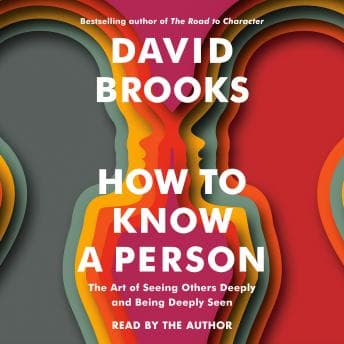

I was making dal at 10 PM—the kind of elaborate weekend cooking project my mother would approve of if she knew I was eating alone again—when David Brooks started talking about the difference between diminishers and illuminators. And I stopped stirring.
Here's the thing about self-help books written by public intellectuals: they're often exercises in ego dressed up as wisdom. I went in skeptical. Brooks is a New York Times columnist, a PBS regular, someone who gets paid to have opinions. The research actually shows that people in positions of institutional authority often struggle with genuine vulnerability. So when he opens with personal anecdotes about his own failures at connection, I found myself asking: why does Brooks really think he's qualified to teach us about seeing others deeply?
But then—and this is where it gets interesting—he earns it.
The Illuminator Framework (Or: Finally, Someone Gets It)
Brooks distinguishes between people who make others feel small (diminishers) and those who make others feel capable and seen (illuminators). This is a fascinating case study in applied social psychology, and what makes it compelling is that he doesn't just theorize. He gives you the actual questions. The specific conversational moves. When he discusses asking "How did that make you feel?" versus "What was that like for you?"—the subtle difference in what each question invites—I literally paused the audiobook to write it down.
Chapter 10 hit differently. Brooks addresses people struggling with depression, and his voice shifts. The warm, almost professorial tone he maintains throughout becomes something rawer. My therapist would have thoughts about this chapter. It's the kind of content that doesn't belong in a book about conversation skills, except it absolutely does, because you cannot truly see someone without understanding the darkness they might be carrying. Anxiety in Relationships & Overcome Anxiety attempts something similar—addressing the internal struggles that shape how we connect—though it takes a more clinical, less nuanced approach.
Brooks Reading Brooks: A Calculated Risk
Author-narrated nonfiction is always a gamble. Sometimes you get someone who writes beautifully but reads like they're filing a tax return. Brooks, though—his delivery matches his writing. There's a warmth there, a genuine curiosity that comes through. He sounds like someone who actually wants you to understand this, not someone performing expertise.
That said. Seven and a half hours is a lot of David Brooks. By part three, when he's discussing life stories and how we construct meaning from our experiences, I noticed my attention wandering. Not because the content was weak (it wasn't), but because his pacing is... contemplative. Meditative. The kind of thing that works beautifully when you're stirring dal at 10 PM but might lose you on a morning jog when your brain wants momentum.
Some listeners apparently stopped halfway through, and I get it. This isn't a book that grabs you by the throat. It's a book that asks you to sit with ideas, to let them marinate. Brooks himself—essentially the protagonist here—exhibits classic intellectual humility mixed with the confidence of someone who's thought about this for decades. It's an unusual combination.
Where the Psychology Actually Tracks
What impressed me most: Brooks doesn't oversimplify. He draws from neuroscience, philosophy, theater (theater!), and education, and somehow it coheres. When he discusses how we construct narratives about ourselves and others, he's essentially summarizing decades of research on narrative identity—the stuff I've been publishing papers about that nobody reads. Except he makes it accessible without making it stupid.
The practical frameworks are genuinely useful. How to ask better questions. How to listen with your whole attention. How to resist the urge to immediately relate everything back to yourself. (That last one? Guilty. Constantly.)
Psychologically, this tracks. The research on active listening, on the power of being witnessed, on how feeling understood literally changes our neurobiology—Brooks isn't making this up. He's synthesizing it in a way that feels actionable rather than academic.
Who This Is For (And Who Should Maybe Read Instead)
If you already think deeply about relationships and want practical tools—yes. If you're looking for a quick fix or a listicle approach to human connection—skip it. If you struggle with audiobooks that don't have a driving plot—maybe get the print version and read it in chunks.
This works best as focused listening. I'd say bedtime, but honestly, you might fall asleep before the good parts. Dedicated listening time, maybe with something to do with your hands. Cooking. Knitting. Something that keeps your body occupied while your mind engages.
Case Closed (For Now)
David Brooks wrote a book about seeing others deeply, and then read it to us in a way that makes you feel seen. That's either very meta or exactly the point. I'm going with the latter.
Is it perfect? No. It's occasionally slow, occasionally too enamored with its own framework. But the core insight—that truly knowing another person is both a skill and a gift—that's worth the seven hours. My therapist would probably say I should practice what Brooks preaches more often. She'd be right.