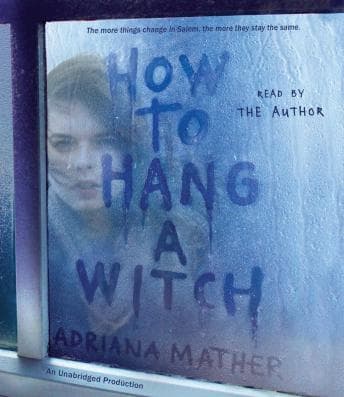

I was making dal makhani at midnight — the kind of elaborate, unnecessary cooking I do when my brain won't shut off — and somewhere between tempering the cumin seeds and stirring the cream in, I realized I'd been standing motionless at the stove for ten minutes because Adriana Mather had just pulled the rug out from under me with the Vivian-is-Anne reveal. My dal suffered. I regret nothing.
Here's the thing about How to Hang a Witch: on paper, it sounds like it shouldn't work. Salem Witch Trials meets teen drama meets ghost romance? That's a lot of genres in a trench coat. Neil Gaiman pulls off a similarly impossible genre pile-up in American Gods, and the audiobook narration there carries the same kind of lived-in weight this one does. But Mather does something psychologically interesting that kept my researcher brain engaged far more than I expected.
The Inherited Guilt Complex Is Real
Samantha Mather is a fascinating case study in what happens when identity gets fused with ancestral sin. She didn't do anything. She's a teenager who moved to Salem. But she carries the Mather name, and the Descendants — this clique of girls whose ancestors were the accused witches — treat her like she personally signed the death warrants in 1692. The protagonist exhibits classic scapegoat dynamics: she absorbs guilt that isn't hers, tries to make herself small, and oscillates between wanting acceptance and wanting to burn the whole social structure down.
And here's where Mather (the author, not Cotton) actually understands human nature — the bullying in this book doesn't feel cartoonish. It feels like the slow, suffocating social exclusion that the research actually shows is more psychologically damaging than overt aggression. The spellwork the Descendants use is supernatural, sure, but strip that away and you've got a pretty accurate portrait of how groups weaponize belonging. My therapist would have thoughts about these characters. Several of them.
The ghost — Elijah — is angry and territorial and initially just wants Sam to stop touching his stuff, which is honestly relatable energy. What makes this character compelling is that he's not just a love interest prop. He's trapped in his own cycle of unresolved trauma, and his arc parallels Sam's in ways that feel deliberate rather than convenient.
When the Author IS the Narrator, It Gets Personal
So Adriana Mather narrates her own book. And she's a descendant of Cotton Mather. Writing about a descendant of Cotton Mather. Narrating a descendant of Cotton Mather. That's... a lot of layers, and it works in ways I didn't expect.
Her voice carries this undercurrent of personal stakes — especially in the scenes where Sam feels the weight of her family history. The fear and discomfort in Sam's voice don't sound performed. They sound lived-in. When she shifts to Elijah's ghost, there's this colder, more distant register that actually made me forget for stretches that it was the same person reading. The villains get a sharper edge, a kind of righteous cruelty that's effective without being over the top.
Is she a professional audiobook narrator? No. And occasionally you can tell — there are moments where the pacing between scenes feels a little flat, like she's reading rather than inhabiting the transition. But the trade-off is an authenticity that a hired voice actor probably couldn't replicate. The author's note at the end, where she talks about her own family connection to Salem, hit differently because I'd been listening to her voice for ten hours. It felt like a confession.
The Cycle-Breaking Metaphor (And Where It Stumbles)
I found myself asking: why does Sam really need to break this curse? On the surface, it's supernatural stakes — people are dying, history is repeating, all that. But the actual emotional engine of this book is about whether you can refuse to inherit your ancestors' worst decisions. Whether cycles of harm — bullying, persecution, othering — are inevitable or chosen.
Psychologically, this tracks. Intergenerational trauma, the compulsion to repeat. The ending's message about breaking the cycle lands because Mather has spent the whole book showing you what the cycle costs.
Where it stumbles: some of the character motivations among the supporting cast feel thin. The Descendants as a group are well-conceived, but individually, a couple of them blur together. I wanted more interiority from the antagonists — why do THEY feel entitled to this grudge? The book tells me they're angry, but I needed to feel the specific texture of that anger more. When you're writing about inherited hatred, the psychology of the haters matters as much as the psychology of the hated.
Also, the pacing in the middle third drags slightly. There's a stretch where Sam is gathering information about the curse that feels more like plot mechanics than character development. At 10 and a half hours, you feel it.
Who Gets the Most Out of This
If you're a YA listener who wants supernatural elements grounded in real psychological dynamics — the bullying, the identity crisis, the weight of family legacy — this is your book. If you're a parent looking for something to spark a conversation about mob mentality and scapegoating with your teen, this is genuinely useful. If you need every character to have airtight motivations, you'll get a little frustrated with the supporting cast.
And if you're a psychology nerd who thinks all stories are really about why people do terrible things to each other — well. You already know where I stand.
The Diagnosis
A smart YA book wearing a ghost story costume. Not perfect — the middle sags, the secondary characters need more depth — but the central psychology is sound, and having the actual descendant of Cotton Mather narrate her own fictional reckoning with that legacy gives the whole thing a weight that purely fictional stories about Salem rarely achieve. My dal was ruined. The book was worth it.