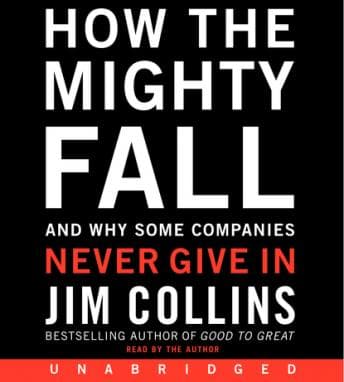

Four hours and forty-two minutes. That's it. Jim Collins wrote a business book that respects your time, and I nearly fell out of my desk chair.
I was prepping a deck for a Series B startup that's showing some worrying signs - revenue growth masking operational rot, leadership getting high on their own press coverage - and I thought, let me revisit Collins before this call. Fired up the audiobook at 1.5x (yes, I actually slowed down for once) and finished it in a single sitting. That almost never happens.
Good to Great Had a Darker, Smarter Sibling
If Good to Great was Collins' love letter to corporate excellence, How the Mighty Fall is the autopsy report. And honestly? The autopsy is more useful. Collins lays out five stages of decline - Hubris Born of Success, Undisciplined Pursuit of More, Denial of Risk and Peril, Grasping for Salvation, and Capitulation to Irrelevance or Death - and each one hit me like a checklist of companies I've watched implode from the inside.
Stage 3, Denial of Risk and Peril, is where I've personally seen the most damage. Collins describes how leaders start explaining away negative data, blaming external factors while internal metrics scream. I sat through a board meeting in 2019 where a CEO literally said "the market doesn't understand us yet" while customer churn was at 18% monthly. That company doesn't exist anymore. Collins would've diagnosed them at Stage 4, maybe Stage 5.
The framework isn't revolutionary - my parents could've told you that getting cocky after a good year is how you lose the business. My mom used to say "don't count the money, count the customers." That's basically Stage 1 prevention in six words, no research team required. Jeff Haden covers similar ground on the gap between gut wisdom and evidence-based performance in Motivation Myth, though I'd give Collins the edge on analytical rigor. But Collins backs it up with data from companies like Circuit City, Zenith, and Ames Department Stores, and the pattern recognition is genuinely sharp.
Collins Reading Collins Is the Right Call
Here's where this gets interesting. Collins narrates this himself, and he's... good? Like, actually good. Not "CEO reading his own memoir in a monotone" good. He brings energy to what could be dry institutional analysis. There's a quality to his delivery that sounds like a professor who's genuinely upset about what happened to these companies - not performative, but like he spent years researching their decline and it bothers him. You can hear the conviction.
The production is clean. No music, no sound effects, no gimmicks. Just Collins talking to you like you're sitting across from him at a conference table. For a sub-5-hour business audiobook, this is exactly the right approach. Don't dress it up. Just deliver the goods.
I will say - and Jenny would say I'm being harsh. Jenny is right - there are moments where Collins repeats his framework summaries a few too many times. In a book this short, you don't need to re-explain the five stages every other chapter. I get it. Hubris, overreach, denial, desperation, death. We're tracking, Jim.
Where It Falls Short (Irony Intended)
The book leans heavily on large, established corporations. Circuit City. Motorola. HP. The decline patterns are useful, but if you're running a 40-person startup burning through Series A cash, the translation requires work. Stage 2 - Undisciplined Pursuit of More - looks very different when you're a $50M enterprise versus a scrappy team trying to find product-market fit. Collins acknowledges this isn't a startup book, but I wish he'd spent even one chapter on how these patterns manifest in younger companies. I've seen Stage 1 hubris kill a startup in 18 months that took Motorola decades to develop.
Also, the "recovery" examples feel thinner than the decline analysis. Collins spends the bulk of his energy on the fall - which is the title, fair enough - but the path back up gets comparatively less rigor. It's like he wrote a brilliant diagnostic manual and then stapled on a pamphlet about treatment.
The Consulting Engagement Wrap-Up
Bottom line: this is the Collins book I actually recommend to founders, not Good to Great. Knowing how things go wrong is more actionable than knowing how things went right for a handful of companies in the '90s. At under 5 hours, the insight-to-runtime ratio is the best in Collins' catalog.
This is what my parents did instinctively. Now it has a TED talk. My dad never had hubris born of success because he was too busy pressing shirts at 6 AM to think about how great he was. But for the rest of us who might forget that - this is a useful listen.
Who should grab this: anyone running a company that's had two good years in a row and is starting to feel invincible. Also anyone who's been burned by a bloated 12-hour business book and wants proof they can be done right.
Who should skip: if you've read the physical book, the audiobook doesn't add enough to justify a relisten. And if you're looking for tactical playbooks, this is diagnostic, not prescriptive.