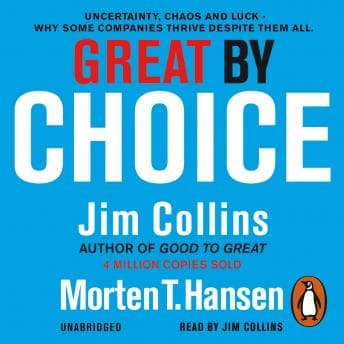

Okay, I have a bone to pick with Jim Collins. Not about the research - the research is solid. My complaint is that this book made me genuinely paranoid about my own engineering team's approach to incident response, and I spent an entire weekend refactoring our runbook because of a concept called "leading above the Death Line." Kevin thought I was losing it. He might've been right.
I picked this up on a Friday evening when I was too wired to sleep after a deploy went sideways but too fried to actually code. Business audiobooks at midnight - this is my life now. And honestly? It was exactly the right energy for that headspace.
The 20 Mile March Is Just Rate Limiting for Companies
TL;DR: Worth your commute. Collins and Hansen spent nine years studying companies that beat their industry indexes by 10x in chaotic, unpredictable environments. The core finding is counterintuitive and - for anyone in tech - weirdly familiar: the winners weren't the boldest or fastest. They were the most disciplined and empirical.
The 20 Mile March concept is the centerpiece, and it's the one that rewired my brain. The idea is simple: hit a consistent performance benchmark every single period, regardless of conditions. Don't sprint in good times, don't collapse in bad times. Collins uses the Amundsen vs. Scott Antarctic expedition as his anchor metaphor, and it works beautifully - Amundsen marched exactly 15-20 miles every day regardless of weather, while Scott pushed hard on good days and hunkered down on bad ones. Amundsen made it. Scott didn't.
If you've ever worked in SRE or capacity planning, this is basically rate limiting but for organizational strategy. And once Collins frames it that way - consistent output, bounded variance - you start seeing it everywhere. Your deployment cadence. Your sprint velocity. Your savings rate. It's annoyingly applicable. The savings rate angle especially - P.T. Barnum made a similar case for disciplined accumulation over flash spending in Art of Money Getting, and while it's a relic of another era, the core logic maps surprisingly well onto Collins's consistency argument.
Fire Bullets, Then Cannonballs (A/B Testing Before A/B Testing Existed)
The second concept that stuck: "Fire Bullets, then Cannonballs." The 10X companies didn't bet big on unproven ideas. They fired low-cost, low-risk "bullets" to calibrate, then once they had empirical validation, they fired "cannonballs" - concentrated resources behind proven concepts. This is literally A/B testing and feature flagging before Silicon Valley made it a religion. The comparison companies? They fired uncalibrated cannonballs - massive bets without empirical grounding - and blew themselves up.
Collins backs this up with paired case studies. Southwest Airlines vs. PSA. Intel vs. AMD. Progressive Insurance vs. Safeco. Each pair operated in the same turbulent environment, but the 10X companies were more paranoid, more measured, more boringly consistent. The data presentation is classic Collins - clean, comparative, hard to argue with.
Now, could some of this have been a blog post? Parts of it, yeah. There are stretches where Collins is hammering the same point with a third and fourth example when you already bought in two examples ago. At 8 hours 45 minutes, it's not egregiously long for a business book, but there's maybe 6 hours of unique insight padded with reinforcement. I bumped it to 1.75x during those sections and didn't miss anything.
Collins Narrating Collins - Weird but It Works
Here's the thing about author-narrated business books: they're usually either fantastic (because the author knows exactly which words to stress) or painful (because authors aren't voice actors). Collins lands solidly in the first camp. He reads like a professor who genuinely loves his data - there's a warmth to how he presents findings, an almost evangelical clarity when he hits a key distinction. He's not Ray Porter - nobody is - but he's got this measured, deliberate delivery that matches the book's thesis about disciplined consistency. Which is either perfect thematic alignment or a happy accident.
No sound effects, no production gimmicks. Just Collins talking through his research like he's presenting at a really good all-hands. Clean audio.
The weakest section is probably the luck chapter at the end. Collins tries to quantify "Return on Luck" - the idea that great companies don't get more luck, they get more value from the luck they receive. It's an interesting framework but feels less rigorous than the earlier concepts. The data gets squishier. You can feel Hansen's tighter analytical hand loosening a bit.
Who Gets the ROI
Perfect for: train, gym. Skip for: bedtime (it'll make you want to go reorganize something).
If you're a team lead, engineering manager, or anyone making resource allocation decisions under uncertainty - the ROI on this audiobook is genuinely high. The frameworks are sticky and immediately applicable. If you've already read Good to Great and Built to Last, this is the best of the three because Hansen's co-authorship tightened the reasoning considerably.
If you hate business books or find case-study methodology unconvincing, this won't convert you. It's still business research. It still has that Collins-ian certainty that can feel overconfident. But compared to every startup book that could've been a blog post? This one actually earned its runtime. Mostly.
I finished this in 4 commutes plus that one insomniac Friday. And I genuinely restructured how I think about on-call escalation procedures because of it. That's more than most business books give me.