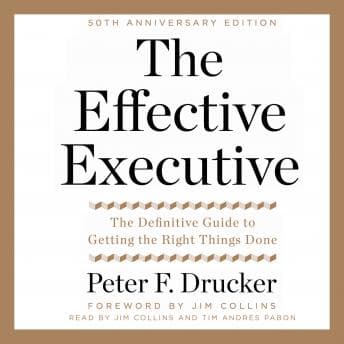

Bottom line: This is the business book that every other business book wishes it was. Six hours. No filler. Actual ideas. I finished it in one cross-country flight and immediately texted three founders I'm advising to stop whatever they're reading and start this.
Look, I've been pretty vocal about my Drucker skepticism. The man wrote in the 1960s. Half the companies he references don't exist anymore. I went in expecting to spend most of my time mentally translating outdated examples into modern contexts. And yeah, there's some of that—you're gonna hear about General Motors like it's still the pinnacle of American industry. But here's the thing: the core framework is so solid that the dated examples almost don't matter.
What My Parents Already Knew
Drucker's five practices—managing time, choosing contributions, mobilizing strengths, setting priorities, making decisions—sound obvious when you list them out. That's because they are. My mom ran a dry cleaning business for 30 years and she did all five instinctively. No MBA, no consulting framework, just immigrant hustle and common sense.
But here's where Drucker earns his keep: he gives you the why behind each practice and the specific how to implement them. The time management section alone is worth the listen. His method of tracking how you actually spend your time (not how you think you spend it) is something I still use with clients. Most executives I work with are shocked when they do this exercise. Shocked and a little horrified.
The contribution chapter hit different for me. Drucker asks: what can you contribute that will significantly affect the performance of the organization? Not what's your job description. Not what are you good at. What will actually move the needle? I've watched so many talented people waste years optimizing the wrong things. This framework would've saved them.
The Jim Collins Bonus Track
This version has Jim Collins doing the foreword, which is basically a mini-lesson on why Drucker matters. Collins—the "Good to Great" guy—reading an intro about Drucker? That's like getting a bonus track from someone who actually knows what they're talking about. Speaking of Collins, I gave Good to Great four stars for similar reasons—timeless frameworks that don't need constant updating. He contextualizes the book for modern readers without being condescending about it.
Timothy Andrés Pabon handles the main text, and he's... fine. Professional. Clear. The kind of narrator who doesn't get in the way, which is exactly what you want for a book like this. You're not here for dramatic voice acting. You're here for ideas delivered efficiently. He delivers.
I will say—and Jenny would tell me I'm being harsh here—the narration can get a bit too calm during the longer theoretical sections. I caught myself zoning out twice during the decision-making chapter, which is ironic given the subject matter. But that's less about Pabon and more about Drucker's writing style in those sections. The man was thorough. Sometimes too thorough.
Six Hours, Maximum Density
Six hours and sixteen minutes. That's it. In the world of bloated business books that pad 45 minutes of insight into 12-hour marathons, this is refreshingly tight. Every chapter has something actionable. I took more notes per hour on this than I have on any business audiobook in the past year.
Is some of it dated? Yes. The examples skew toward mid-century manufacturing and government. You'll need to do some mental translation for tech contexts. But the principles transfer cleanly. When Drucker talks about effective meetings, he could be describing the Zoom hell we all live in now.
Who Gets Value Here (And Who Doesn't)
Skip this if: you're looking for tactical startup advice or growth hacking frameworks. Drucker is playing a longer game. He's teaching you how to think about effectiveness, not giving you a checklist. Some people want the checklist. That's what something like Get Sh*t Done tries to provide, though I only gave it three stars because checklists without frameworks don't stick.
Absolutely listen if: you're in a leadership role and feel busy but not productive. Or you've been promoted and suddenly realize you have no idea how to actually manage your time and attention. Or you've read a dozen modern business books and want to understand where all those ideas originally came from. (Spoiler: a lot of them came from here.)
Adding This to the Client Rotation
I'm putting this in my "recommend to every new client" rotation. It's one of maybe five business audiobooks I'd say that about. The fact that it was written 60 years ago and still holds up? That's not nostalgia talking. That's just good thinking that aged well.
My 2.0x speed worked fine here, by the way. Pabon's pacing is measured enough that you can push it without losing anything. Skip to chapter 3 if you're impatient—that's where the practical frameworks really kick in. But honestly? Just listen to the whole thing. It's six hours. You've wasted more time on worse ideas.