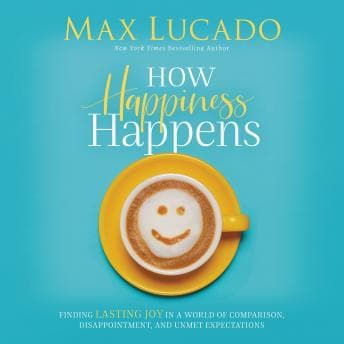

Can psychology and faith actually agree on anything? I spend my days analyzing human behavior through the lens of research and data, and I'm usually pretty skeptical when someone promises me "the secret to lasting happiness." My therapist would have thoughts about that phrasing. But Max Lucado's approach in How Happiness Happens caught me off guard. He's essentially making the same argument that positive psychology researchers have been making for decades—that happiness is an outward-facing behavior, not an internal acquisition project—but he's doing it through biblical teachings. And honestly? The research actually shows he's onto something.
I listened to this during my morning jogs through Cambridge, which turned out to be perfect timing. There's something about Lucado's central thesis—that happiness happens when you give it away—that pairs well with endorphins and cold air. The book isn't complicated. It's under five hours, and the core message could probably fit on an index card. But that's not a criticism. Sometimes the most psychologically sound advice is also the simplest. We just don't want to hear it because it requires us to stop navel-gazing.
The Research Behind the Sermon
What makes Lucado compelling is that he understands human nature in a way that tracks with actual research on subjective well-being. The happiness-through-service model isn't just feel-good religious talk—it's backed by studies on prosocial behavior and hedonic adaptation. Mindful Athlete: Secrets to Pure Performance explores similar territory around how shifting focus outward—toward the game, the team, the moment—creates better outcomes than obsessing over internal states. When he says "people are a joy," he's describing what researchers call social connection as a primary predictor of life satisfaction. I found myself nodding along more than I expected. (Don't tell my secular academic colleagues.)
The structure is practical and accessible. Lucado uses storytelling and relatable anecdotes rather than heavy theological arguments, which makes this work as a self-help book even if you're approaching it from a purely psychological perspective. He's not trying to be deep. He's trying to be useful. There's something refreshing about that directness. The reflection questions in the companion PDF actually seem designed to prompt genuine self-examination rather than just busy work.
Is this groundbreaking material? No. If you've read anything on positive psychology or gratitude practices, you'll recognize the framework. But Lucado presents it with warmth and without the smugness that sometimes creeps into self-help. He's an encourager, not a lecturer.
Ben Holland's Steady Hand
Ben Holland's narration is exactly what this book needs—warm, clear, steady. His deep voice has this academic-yet-friendly quality that makes you feel like you're getting advice from someone who genuinely wants good things for you. No dramatic flourishes, no performative emotion. Just solid, soothing delivery that lets the content breathe.
The audiobook-exclusive content is actually worth mentioning. There's a sermon from Lucado himself on how worship leads to a happy heart, plus a conversation between Max and Ben that adds a personal dimension you don't get in the print version. Nice touch—gives you a sense of the real humans behind the production. The audio quality is clean throughout, with some music and effects in those bonus segments that work without being distracting.
One note: if you need high-energy narration to stay engaged, this might feel too mellow. Holland's pacing is steady, which is perfect for the reflective content but might lull you during a particularly boring commute. I'd bump it to 1.25x speed if you're the type who zones out easily.
Skip This If You Want Secular Self-Help
If you're not interested in faith-based content, this probably isn't for you. Lucado is a pastor, and while the psychological principles are sound, they're wrapped in Christian teachings. That's not a flaw—it's the point. But know what you're getting into. For fans of Christian inspirational content, though? This is a solid listen. Encouraging without being saccharine, practical without being preachy.
I finished this feeling... lighter? Which is not something I say often about self-help books. Wish left me with that same unexpected emotional shift—a sense of hope I didn't see coming. Usually I'm too busy cataloging the logical fallacies. But there's something to the simplicity here. Happiness happens when you give it away. It's not a revolutionary insight. But maybe that's the point—the best psychological truths rarely are.