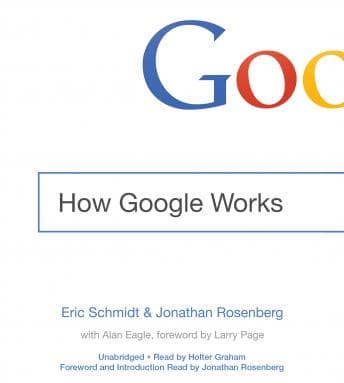

I was reorganizing my home office at midnight - Jenny had finally gone to bed, and I was stress-sorting old McKinsey deliverables into shred vs. keep piles - when Holter Graham started explaining Google's hiring philosophy. I stopped shredding. Sat on the floor surrounded by decade-old strategy decks. Because here's the thing: I spent eight years at a firm that believed it had cracked the code on talent acquisition, and Schmidt and Rosenberg just casually described a system that would've made half my former partners uncomfortable.
Bottom line: How Google Works is a solid B+ business book that packs maybe 5 hours of genuinely useful insight into 10 hours of runtime. The Google-specific anecdotes are gold. The management philosophy sections are where it earns its keep. The rest is victory-lap padding from two guys who had front-row seats to one of the most consequential companies in history and - understandably - want you to know about every single moment.
My Parents Ran a Dry Cleaner, Not a Search Engine. The Principles Are Weirdly Similar.
The book's core argument is about "smart creatives" - multifaceted employees who combine technical skill, business sense, and creative energy. Schmidt and Rosenberg argue that these are the people who actually build great products, and that management's job is basically to get out of their way while creating an environment dense enough with talent that collisions produce innovation.
Here's what got me sitting on that floor: my parents didn't have a vocabulary for this, but they did it instinctively. My mom could spot a worker who genuinely cared about getting shirt collars right versus someone just collecting hours. She couldn't articulate it as "hiring for learning ability over expertise," but that's exactly what she was doing when she'd pick the eager kid with no experience over the guy who'd worked three other cleaners but didn't give a damn. This is what my parents did instinctively. Now it has a TED talk. Carnegie figured out the people-reading instinct side of this equation decades earlier in How To Win Friends And Influence People — though I'd argue my mom's calibration for genuine effort versus performed competence was sharper than anything in that book.
The 10X thinking chapter is where the book really earns its credit. Schmidt explains why Google pushed teams to think about 10X improvement rather than 10% - not as motivational fluff, but as a structural decision-making filter. A 10% improvement keeps you optimizing the existing system. A 10X target forces you to throw out your assumptions entirely. I've seen this fail at three different companies when leaders adopted the language without the infrastructure - they'd tell teams to "think big" while keeping quarterly OKR cycles that punished anything that wasn't immediately measurable. Schmidt at least acknowledges you need the org structure to support the ambition. Most CEO book-club disciples skip that part.
Holter Graham Doing the Heavy Lifting
Let's talk about the listen itself. Graham is genuinely excellent here. Business audiobooks live or die on the narrator's ability to make corporate strategy sound like something other than a compliance training module. Graham threads it - there's a conversational quality to his delivery that makes Schmidt and Rosenberg's anecdotes land like stories told over drinks rather than keynote speeches. At one point, apparently, listeners have noted he sounds like Larry Page himself, which is either excellent voice work or a weird coincidence. Either way, it adds a layer of authenticity that you don't get from the printed page.
Jonathan Rosenberg narrates the foreword and introduction himself, and - look, he's a brilliant product executive. He is not a voice actor. It's serviceable. It's workmanlike. Skip to chapter 1. Thank me later. Once Graham takes over, the whole thing lifts.
The "Consensus Requires Dissension" Problem
The management maxims scattered throughout - "Exile knaves but fight for divas," "Consensus requires dissension" - are the most quotable and also the most dangerous parts of this book. Dangerous because they sound incredible in a slide deck and require enormous organizational courage to actually implement. I've watched a SaaS startup CEO quote the "fight for divas" line to justify keeping a toxic VP of Engineering for an extra year. That VP crater'd two product teams before getting fired. The book gives you the Google version of these principles, where they had the resources, the brand gravity, and the founder authority to make them work. Your 40-person Series B company is not Google. Adjust accordingly.
That said, the chapter on decision-making - specifically the framework for when to seek consensus versus when to let the most informed person just decide - is genuinely useful. I've adapted a version of it for three clients. It works.
Who Gets the ROI
If you're running a company, managing a product team, or trying to build a hiring culture that doesn't suck, this is worth your time at 1.5x. The Google-specific stories provide enough concrete texture that you're not just getting abstract theory. Tech founders and operators will get the most mileage. If you're looking for a step-by-step playbook for a non-tech business, maybe 40% of this applies directly.
If you're a consulting refugee like me who's read every strategy framework twice - you'll still find a few new angles. Not a revolution, but a solid sharpening.
Jenny would say I'm being harsh. Jenny is right. It's a good book. It's just not a 10-hour book. At 2.0x speed, though, that problem solves itself.









![Steve Jobs [unabridged audiobook] audiobook cover](/_next/image?url=https%3A%2F%2Fcovers.audiobooks.com%2Fimages%2Fcovers%2Ffull%2F9788499923406.jpg&w=1920&q=75)