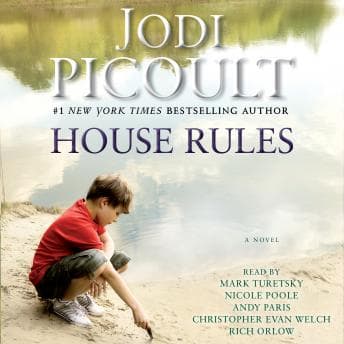

Twenty years of teaching has taught me that the hardest thing in the world is understanding teenagers. Picoult gets this. She gets it in a way that made me pause my lakefront walk with Denise and just stand there, staring at the water, thinking about every student I've ever misjudged.
House Rules isn't just a murder mystery wrapped in a family drama. It's a brutal examination of how we interpret behavior—and how catastrophically wrong we can be.
Five Voices, One Fractured Family
Look, I'm usually skeptical of full-cast productions. They can feel gimmicky, like the audiobook equivalent of a movie adaptation that's trying too hard. But this one? This one earns it.
Five narrators—Andy Paris, Christopher Evan Welch, Mark Turetsky, Nicole Poole, and Rich Orlow—each take on a family member's perspective, and the effect is genuinely disorienting in the best way. You're not just hearing the story from different angles. You're experiencing how fundamentally these people misunderstand each other, even living under the same roof.
Paris handles Jacob, our protagonist with Asperger's, with careful precision that never tips into caricature. (And believe me, I've seen plenty of media representations that do exactly that.) There's warmth there, but also a kind of clinical detachment that makes Jacob's isolation palpable. Nicole Poole as Emma, the mother, brings this exhausted resignation that hit uncomfortably close to home—it's the voice of someone who's been advocating for their kid against a world that doesn't get it for so long that she's running on fumes.
The diction is perfect throughout. Not a mumbled word in twenty hours. Which, okay, sounds like a basic requirement, but you'd be surprised how many audiobooks fumble this.
The Picoult Formula (And Why It Works Here)
If you've read her before—My Sister's Keeper, Small Great Things—you know the approach. I Found You works similar territory with its fractured family dynamics and mystery structure. Moral complexity, family under pressure, courtroom drama, multiple perspectives. House Rules follows the playbook, and honestly, that's fine. The formula works because Picoult does her research. The Asperger's representation here feels genuinely informed, not performative.
But here's the thing that kept nagging at me during those late-night grading sessions: the pacing. This is a long audiobook. Nearly twenty hours. And somewhere around the middle, I found myself getting impatient. I knew where we were headed—the trial, the reveal, the reckoning—and the journey there felt padded at times. The educational asides about autism spectrum disorder are valuable, important even, but they occasionally interrupt the narrative momentum.
My students would probably bail around hour eight. I didn't, but I understood the temptation.
That Ending Will Start Arguments
I need to talk about this without spoiling anything, which is tricky. Picoult makes a choice at the end that's going to frustrate some readers. It's ambiguous. It's deliberately unresolved. And I get why that bothers people—we want closure, especially after investing twenty hours.
But here's my take, and it's very much an English teacher take, so bear with me: the ambiguity is the point. The whole book is about how we construct narratives around behavior we don't understand. Jacob can't read social cues, and neither, ultimately, can we as readers. We're left in the same uncertain space his family occupies. It's uncomfortable. It's supposed to be.
(Don't tell my students I said that. They hate when I defend ambiguous endings.)
Your Listening Assignment
This is essential listening if you want to understand neurodivergence better, if you love courtroom drama with emotional stakes, or if you're a Picoult fan who hasn't caught up with her backlist. Lincoln Highway also benefits from that full-cast treatment, though it tackles very different themes. The full cast production genuinely elevates the material—I'd argue this is one of those books that works better in audio than on the page.
Skip it if you need fast pacing or tidy resolutions. If ambiguity makes you want to throw your phone in the lake, this isn't your book. Also maybe skip if you're grading papers while listening—it demands more attention than background listening allows. I learned that the hard way.
Class Dismissed
The German Reader's Choice Award for Audiobook wasn't wrong. This is a thoughtful, well-crafted production of a book that asks hard questions about justice, family, and the stories we tell ourselves about people we think we know.
Worth pausing the faculty meeting for. Definitely.