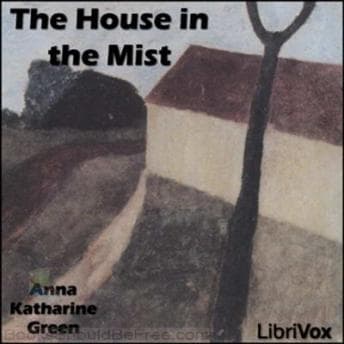

Anna Katharine Green understood something fundamental about human psychology: we are drawn to danger precisely because we know we shouldn't be. Her narrator Hugh Austin tells us this directly in the opening moments—youth seeks the strange, the unknown, and sometimes the terrible. And then he walks straight into a house that will test that theory.
I was chopping onions for a dal that would take two hours I didn't have when Carolin Kaiser's voice filled my kitchen with fog. Actual atmospheric fog. Her German accent—and yes, it's noticeable—wraps around Green's Victorian prose like mist around that titular house. Some listeners apparently find this distracting. I found myself thinking: this is exactly how a gothic tale should feel. Slightly foreign. Slightly off. The kind of voice that makes you lean in rather than settle back.
The Psychology of Shelter That Isn't Refuge
Green was writing detective fiction before the genre had a name, and you can feel her legal training in every revelation. The setup is deceptively simple: a traveler seeks shelter, stumbles into a family gathering, witnesses a last supper of sorts where inheritance hangs heavy in the air. But what makes this work as a psychological study is how Green constructs motivation.
Every character in that house wants something. The research mentions "past misdeeds and murder," and Green doesn't rush to expose them. That same slow-burn revelation of hidden motives drives Guest List: A Novel, where every wedding guest is performing a version of themselves. She lets you sit with these people, observe their glances, their hesitations. Hugh Austin functions as our proxy—young, untrammeled (Green's word, and I love it), watching a family implode around a fortune. The protagonist exhibits classic outsider-witness behavior: he notices everything precisely because he has no stake in the outcome. Or so he thinks.
At under two hours, this is a tight little puzzle box. No padding. No extended descriptions of Victorian wallpaper. Green knew that mystery lives in what people don't say, in the spaces between polite conversation.
Carolin Kaiser's Atmospheric Gamble
Here's where I have to be honest about the data gap: I couldn't find detailed information about how Kaiser differentiates between characters. What I can tell you is that her pacing works for this material. The "misty atmosphere" that listeners praise isn't just metaphor—there's something slightly dreamlike in her delivery that matches Green's prose style.
The accent question is real, though. Some native English speakers apparently bounced off this hard (the Audible rating sits at 1.5 stars, which feels harsh). I had a similar reaction to the atmospheric narration in Copper River—some technical choices enhance the mood even when they're unconventional. But I found myself asking: why does a German accent reading American Victorian gothic bother some listeners so much? My therapist would have thoughts about this—something about how we expect "classic" literature to sound a certain way, and disruption triggers resistance.
This is a LibriVox production, which means volunteer narration, no sound effects, no production polish. You're getting one voice, one story, no frills. For a foggy evening listen, that simplicity works. For someone expecting Audible-quality production values, adjust expectations accordingly.
Who Should Wander Into This House (And Who Should Keep Walking)
If you're a completist for early detective fiction—Agatha Christie's grandmother, essentially—this is required listening. If you appreciate atmosphere over action, psychological tension over chase scenes, this delivers. Halloween-adjacent material, yes. But also insomnia material. The kind of story you put on at 2 AM when sleep won't come and you want company that won't demand anything from you.
Skip this if accents genuinely distract you from content (no judgment, brains work differently), you need explicit character voice differentiation, or you're looking for a long-form commitment. At 1 hour 50 minutes, this is barely a commute for some people.
The pacing question is interesting. Some listeners found it "good," which is vague enough to be useless. I'd say: it's deliberate. Victorian deliberate. If you need to speed it up to 1.25x, you probably will, and that's fine. The story can handle it.
Priya's Final Assessment
Anna Katharine Green wrote this in an era when women weren't supposed to understand crime, law, or the darker impulses of human nature. She understood all three. This audiobook is a tiny window into that understanding—a traveler seeking shelter, finding something else entirely, and learning that the impulses of an unfettered spirit sometimes lead exactly where they shouldn't.
Kaiser's accent won't work for everyone. The production is bare bones. But the psychology? The psychology tracks. Green knew why people do terrible things to each other, and she knew how to make you watch.