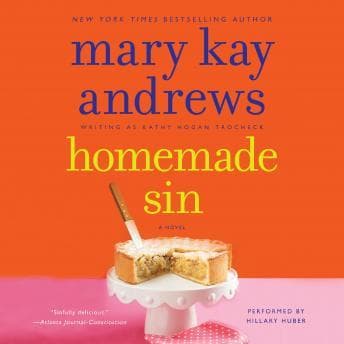

Look, I need to get something off my chest before we go any further: if you're going to narrate a book set in Atlanta, written by a former Atlanta Journal-Constitution reporter who clearly knows every strip mall and back road in the metro area, you cannot — cannot — mispronounce the place names. I don't care how good your character voices are. Every time Hillary Huber mangled a street name or neighborhood, I could feel Mary Kay Andrews somewhere in Georgia wincing. It's like listening to someone narrate a book set in Chicago and calling it "Chi-CAW-go." You lose me. You lose the locals. You lose the texture of the city that the author worked so hard to build.
And that's the frustrating thing about this audiobook, because the book itself? Pretty good.
Callahan Garrity Is the Teacher Who Runs the After-School Detention AND the Investigation
I've got a soft spot for amateur detectives who are too smart and too stubborn for their own good. Callahan Garrity is that person — ex-cop turned cleaning business owner who simply will not leave her cousin Patti's death alone, even when her own family tells her to back off. This reminds me of what Hemingway said about courage being grace under pressure, except Callahan's version of grace involves arguing with relatives at the funeral and then showing up uninvited to interrogate people while still wearing her House Mouse uniform.
Andrews' journalism background shows up in the plotting. The story moves like a well-edited feature piece — tight, multiple threads, no wasted scenes. At under ten hours, it doesn't overstay its welcome. The carjacking that kills Patti feels wrong from the jump, and Callahan's instinct to dig into it isn't just stubbornness — it's the reaction of someone who understands that crimes are supposed to make sense, and this one doesn't. The suburban setting works against the violence in a way that keeps you unsettled. Something about Patti's clean, ordinary life doesn't match the mess of her death, and Andrews lets that dissonance do a lot of heavy lifting.
What I appreciate — as someone who spends his days trying to get teenagers to notice subtext — is that Andrews doesn't make Callahan infallible. She's nosy and she knows it. She's defensive about it. That self-awareness keeps her from becoming one of those insufferable fictional detectives who are always three steps ahead. Callahan trips over her own assumptions. She gets in her own way. She's human about it. That same quality — a protagonist who earns your investment precisely because they're fallible — is the one thing I genuinely missed when I read Last Orphan: An Orphan X Novel, where Evan Smoak is so relentlessly competent that you almost stop worrying about him entirely.
The Narrator Problem (Or: When Good Voices Meet Bad Geography)
Here's where I'm genuinely torn. Hillary Huber is good at differentiating characters. She is. You can tell when someone new walks into a scene because the voice shifts — pitch, cadence, attitude. That's not nothing. For a single-narrator mystery with a big cast, keeping everyone distinct is real work, and she handles it.
But the Southern accents. I'm a Midwesterner, so I'm not the authority here, but even I could tell some of them were — how do I put this charitably — aspirational rather than authentic. There's a cartoonish quality to a few of the voices that undercuts the tension Andrews is building. You're supposed to be worried about Callahan poking around dangerous territory, and instead you're thinking, "That accent just traveled from Savannah to somewhere in the Ozarks mid-sentence."
And the place names. I was listening to this during a late-night grading session — red pen in one hand, earbuds in, stack of sophomore essays on Gatsby that were all, predictably, about the green light — and even half-distracted, the mispronunciations pulled me out. If the narrator had spent thirty minutes with a local pronunciation guide, this would've been a different listening experience. Atlanta is a character in this series, and when you can't say its streets right, you're essentially miscasting that character.
Who Gets the Hall Pass and Who Gets Detention
If you're already invested in the Callahan Garrity series, you'll want this one. Third book, so the relationships have depth, the supporting cast (especially the House Mouse crew) has personality, and Andrews has hit her stride with the plotting. If you're a cozy mystery fan who can tolerate imperfect narration for the sake of a smart protagonist and snappy dialogue, you'll be fine.
But if you're from Atlanta — or if you're the kind of listener where a bad accent is a dealbreaker — be warned. The narrator's strengths and weaknesses are in constant tension here, and which one wins depends on your tolerance.
I'd also say this is a solid commute or housework listen. It's not the kind of mystery that demands your full concentration, but it rewards it when you give it.
The Margin Note I'd Leave My Students
The prose deserves to be savored — Andrews writes with the efficiency of someone who filed newspaper copy on deadline, and there's a crispness to her sentences that I wish more mystery writers aimed for. The audiobook almost gets there. Almost. Huber's character work fights against her accent work, and the result is an experience that's good but keeps bumping into itself. Worth your time if you adjust your expectations. Not worth a credit if the accent thing is going to drive you up a wall.
My students would hate this. I kind of liked it. That's usually a decent sign.