
"Ideas excite me. Empathy grounds and centers me."
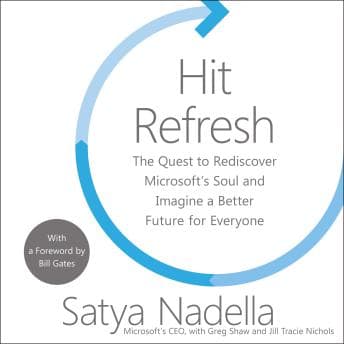
That line hit me somewhere around hour two, and I had to stop walking. Denise kept going for about thirty feet before she turned around on the lakefront path and gave me that look — the one that says "you're having a book moment again, aren't you?" I was. Because here's a CEO of one of the largest companies on Earth, and his thesis isn't about market share or cloud computing margins. It's about empathy. An English teacher's ears perk up at that kind of thing.
When the CEO Reads His Own Homework
Let me be upfront: Satya Nadella narrating his own book is both the greatest strength and the most interesting limitation here. His voice carries genuine conviction — you can hear the difference between when he's reciting corporate strategy and when he's talking about his son Zain's cerebral palsy and how that experience rewired his understanding of what it means to lead with compassion. Those passages have a weight to them that no hired voice actor could replicate. The slight catch in his delivery, the places where his cadence shifts — that's a man remembering, not performing.
But Nadella is not a professional narrator. He reads like an extraordinarily intelligent person reading aloud from something he cares deeply about, which is exactly what's happening. There's a flatness to certain stretches — particularly the chapters on cloud infrastructure and competitive positioning — where you can feel the material shifting from personal to presentational. Shridhar Solanki handles some of the reading duties and brings a steadier, more polished delivery, but the contrast between the two voices can be slightly jarring. You adjust. It's worth adjusting.
The narrator understands that pause is punctuation — except here, the pauses aren't always deliberate artistry. Sometimes Nadella just... lands on a sentence oddly. And honestly? That authenticity matters more to me than polish. This reminds me of what Hemingway said about writing — that the dignity of movement of an iceberg is due to only one-eighth of it being above water. Nadella's delivery is that visible eighth. You sense the weight underneath.
Cricket, Hyderabad, and the Soul of a Corporation
The early chapters on Nadella's childhood in India are genuinely the best part of this book, and I don't think that's an accident. His father was a civil servant, his mother a Sanskrit scholar, and young Satya wanted to play cricket professionally. That's it. That's where one of the most powerful tech executives on the planet started. There's a lovely specificity to his descriptions of growing up in Hyderabad — the way he frames his cricket obsession not as a sports anecdote but as his first lesson in team dynamics and leadership under pressure.
When the book pivots to Microsoft's internal transformation — the shift from Ballmer's combative "stack ranking" culture to Nadella's emphasis on a "growth mindset" (borrowed heavily from Carol Dweck, which he credits openly) — it reads like a case study that actually has a pulse. The company was calcifying. Windows was king and nothing else mattered. Nadella describes walking into meetings where teams were literally fighting each other for resources instead of competing with Google or Apple. His solution wasn't a reorg chart. It was asking people to stop being know-it-alls and start being learn-it-alls.
My students would hate this. I love it. (They'd call it "corporate motivational poster energy." They wouldn't be entirely wrong about some chapters.)
Where the Algorithm Gets Fuzzy
Here's where I have to be honest: the final third drags. When Nadella moves into his predictions about AI, mixed reality, and quantum computing — remember, this was published in 2017 — some of it reads like a keynote address rather than a book. The AI discussion is fascinating in hindsight given everything that's happened since, but at the time of writing, he's painting in broad strokes. The chapters on government regulation and privacy policy feel dutiful rather than passionate. You can almost hear the difference in his voice — the conviction thins out.
At 7 hours and 27 minutes, it's a reasonable commitment. But I'd argue the book is really 5 hours of genuine insight wrapped in about 2 hours of corporate responsibility white paper. Worth pausing the faculty meeting for? The first two-thirds, absolutely. The rest, well — it's fine background for grading papers at 11 PM, which is exactly how I finished it.
If you loved Shoe Dog by Phil Knight — another CEO memoir where the personal story overshadows the business strategy — this is its spiritual successor, though Knight is a wilder storyteller. The same pull toward personal truth over institutional narrative is what drew me to Brown Girl Dreaming — a completely different world on the surface, but that same quality of someone using their origin story to explain everything that came after. Nadella is more measured, more philosophical. Less narrative drive, more reflective depth.
Who Gets the Most Out of This
People in leadership positions who are tired of the "move fast and break things" gospel. Teachers, actually — anyone whose job is about culture change in stubborn institutions. (Principal Martinez, I'm looking at you.) Tech enthusiasts who want the human story behind the pivot to cloud. Skip it if you want a pure business strategy book — this is more memoir than manual. And if you need a dynamic narrator to keep you locked in, the delivery here is sincere but won't carry you through the slower stretches.
The Annotation in the Margin
The prose deserves to be savored in the personal chapters. Let Nadella's voice carry you through Hyderabad and through the early Microsoft struggles. When it starts sounding like a TED talk, give yourself permission to let your attention drift a little. The man wrote an honest book about running a company and raising a family with a disabled child and trying to figure out what empathy actually means when you have 120,000 employees. That's not nothing. That's pretty close to everything, actually.