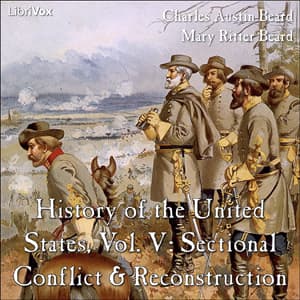

"The Civil War was not a contest over abstract principles." That line hit me about thirty minutes in, and I had to pause the recording. Beard wrote that in 1921, and here I am a century later nodding along like he's sitting across from me at a briefing table. The man understood something a lot of modern historians dance around - wars happen because of money, land, and power. Everything else is just the story we tell ourselves afterward.
Let me cut to the chase. This is a LibriVox production, which means volunteer narrators reading public domain texts. If you're expecting Ken Burns-level production, adjust fire. But if you want solid historical analysis delivered clearly enough to follow during your morning commute? Mission accomplished.
The Beard Approach: Economics Over Mythology
Charles and Mary Beard were doing something radical for their time - treating American history like it actually happened for reasons beyond "great men making great decisions." This volume covers Sectional Conflict and Reconstruction, roughly 1850 through the 1870s, and it's dense in the best way. They connect the dots between cotton economics, Western expansion, railroad interests, and the political machinery that eventually ground itself into civil war.
What struck me - and I've read plenty of Civil War history, trust me - is how they treat Reconstruction not as an epilogue but as its own complex campaign. The political maneuvering, the economic reshuffling, the constitutional amendments. They don't shy away from the failures. The Beards wrote this before the Lost Cause mythology had completely calcified into Southern textbooks, so you get a relatively clear-eyed assessment. Not perfect by modern standards, obviously. But honest for 1921.
The writing style is what I'd call "educated civilian." No academic jargon, no footnote warfare. Just clear analysis. Ranger and I got through the whole thing during a week of driving between client sites in Houston and Dallas.
The Volunteer Narrator Situation
Here's where I have to be straight with you. LibriVox uses different volunteers for different chapters, and the quality varies. The same volunteer inconsistency shows up in Bible (WEB) Old Testament - complete, though that project's sheer scale makes it more understandable. Some readers are excellent - clear diction, good pacing, obviously engaged with the material. Others sound like they're reading their grocery list. The editing between sections can be rough. I noticed a few spots where recordings clearly happened in different rooms, maybe different years.
But here's the thing - it's free. And the content is worth the occasional audio hiccup. I listened at 1.25x, which smoothed out some of the slower readers and made the whole thing feel more like a lecture than a bedtime story. Which is appropriate, because this IS educational content. It's not trying to be entertainment.
The lack of professional polish actually reminded me of some of the better military history briefings I've sat through. The information matters more than the presentation. You're not here for vocal performance. You're here because you want to understand how America tore itself apart and tried to stitch back together.
Who This Is For (And Who Should Skip It)
If you're a history buff who wants primary source analysis from a century ago - when the Civil War was still living memory for some Americans - this is valuable. The Beards interviewed people who remembered this stuff. That perspective is irreplaceable. Skip this if you need your history wrapped in dramatic narration with sound effects and emotional peaks. You'll be frustrated.
I found myself taking mental notes throughout. The sections on the economic transformation of the South during Reconstruction, the railroad land grants, the political realignment - it's the kind of foundational knowledge that makes modern political commentary actually make sense. That same foundational approach is what makes United States Constitution worth a listen - understanding the framework helps everything else click into place. You start seeing patterns.
Cooper's Assessment
At just under three hours, it's not a massive time investment. I've sat through longer PowerPoint briefings with less useful information. The Beards knew how to be concise, which I respect. No padding, no repetition for emphasis. They trusted their readers - or in our case, listeners - to keep up.
Ranger approved this one, though he did give me a look during one particularly monotone chapter. Fair criticism. But the content earned its place in my rotation. Sometimes you want entertainment. Sometimes you want education. This is firmly in the education column, and it delivers.



![Steve Jobs [unabridged audiobook] audiobook cover](/_next/image?url=https%3A%2F%2Fcovers.audiobooks.com%2Fimages%2Fcovers%2Ffull%2F9788499923406.jpg&w=1920&q=75)