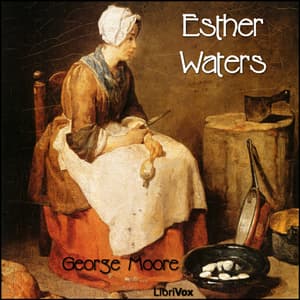

I wasn't expecting a Victorian novel about a "fallen woman" to wreck me this hard. I was working on a logo redesign for a local bakery—super chill project, lots of pastels—and I had this playing in the background thinking it would be nice period drama vibes. Reader, I was not prepared.
Esther Waters is this young kitchen maid who gets pregnant after being seduced by a fellow servant, and then he just... leaves. Disappears. And she decides to keep her baby and raise him alone in 1890s England, which is basically choosing the hardest possible path in a world designed to crush women like her. The opening scene with her watching the train disappear? That image stayed with me for days. It's so quiet and devastating.
The Gut-Punch Moments
George Moore doesn't do melodrama the way I expected from Victorian lit. There's no swooning or dramatic declarations. Instead it's these small, grinding indignities that pile up until you're just... sitting there with your hand over your mouth. Esther pawning her things. Esther being turned away from jobs because she has a child. Esther watching other women give up their babies because they can't afford to keep them.
And here's the thing that got me—she's not a saint. She's stubborn, sometimes frustratingly so. She makes choices I wanted to shake her for. But that's what makes her real? She's just a person trying to survive with the cards she was dealt, and Moore never lets you forget how stacked the deck was against working-class women.
My abuela raised four kids basically alone after my grandfather passed. She would have recognized Esther. That bone-deep determination to keep your family together no matter what it costs you. I had to pause around chapter... I don't know, somewhere in the middle when Esther is debating whether she can afford to keep her son. Frida jumped on my lap and I just held her for a while.
The LibriVox Reality Check
Let's talk about the narration because this is a LibriVox production and that comes with caveats. Multiple volunteer readers means the voice changes chapter to chapter, sometimes mid-section. Some readers are genuinely lovely—warm, measured, good at the emotional beats. Others are... fine. Serviceable. A few made me wince a little.
The character differentiation is hit or miss depending on who's reading. Sometimes the dialogue flows naturally, other times it's a bit flat. And yeah, there's some background noise and audio quality variation because that's just what you get with volunteer productions. But honestly? For a free audiobook of a novel this good, I'm not complaining. The story is strong enough to carry you through the rougher patches. Just don't expect Julia Whelan-level polish.
Why This 1894 Novel Still Hits
The way society judges women for their "mistakes" while the men who made those mistakes with them just... walk away and face zero consequences? Still relevant. The impossible math of being a single mother without support? Still relevant.
Moore was apparently controversial for writing this—too sympathetic to a "ruined" woman, too critical of Victorian morality. Good. Someone needed to say it.
The pacing is slower than contemporary fiction, which might lose some people. There are sections about horse racing and betting that felt like they went on forever (apparently Moore was really into that world). But when the story focuses on Esther's emotional journey, it's devastating in the best way.
I ugly-cried at least twice. Maybe three times. The spreadsheet says three but one of those might have been PMS-adjacent so I'm not counting it.
If you loved The Mill on the Floss or The Tenant of Wildfell Hall, this belongs on your list. I had a similar reaction to Book of Life: A Novel—different era, but that same focus on women navigating impossible systems. It's less gothic than Brontë, more grounded and gritty. But that same fire is there—that insistence on telling women's stories that polite society would rather ignore.
Who should listen: Anyone who wants Victorian lit with real emotional weight and a heroine who earns every tear. Who should skip: If you need consistent narration quality or can't handle slower pacing with horse racing tangents, this might frustrate you.
Fair warning: the language and attitudes are very much of their time. Some passages made me cringe. But Moore's sympathy is clearly with Esther, even when the world around her is cruel.
Grab Your Blanket, This One's a Keeper
This is a rainy Sunday book. Pour some tea, wrap yourself in a blanket, and let yourself feel things. Abuela would have loved this one.