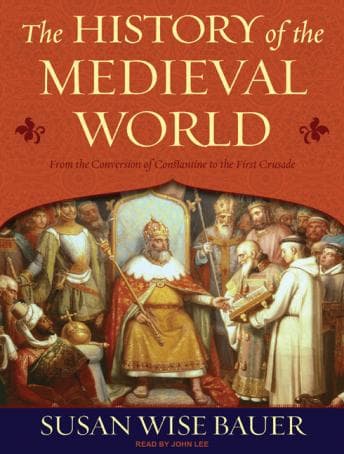

Twenty-three hours. Let me just say that again. Twenty-three hours of medieval history, from Constantine to the First Crusade, covering every continent that had people doing interesting things on it. I started this thing on a round-trip consulting gig to Houston and back - three days of windshield time on I-35 - and I still wasn't done. Had to finish the last four hours on the back patio with Ranger while Linda was inside watching something on Netflix. That dog now knows more about the T'ang Dynasty than most college sophomores.
Here's my complaint, and I'm leading with it: Susan Wise Bauer wrote a book that covers the entire medieval world - China, India, Japan, the Islamic caliphates, sub-Saharan Africa, the Americas, Byzantium, and Western Europe - and John Lee narrates all of it in roughly the same register. The Fall of Rome gets the same vocal energy as a trade dispute between Korean kingdoms. A caliph gets assassinated, and Lee rolls right through it like he's reading a weather report. The man is an Audie Award winner, and his diction is impeccable, but when Charlemagne gets crowned Holy Roman Emperor, I need a beat. Give me a pause. Let the moment land. Lee doesn't do that, and for a 23-hour commitment, that emotional flatness becomes a real endurance issue.
The Thesis That Holds 700 Years Together
Let me cut to the chase on the book itself: Bauer's central argument is that between the 4th and 12th centuries, rulers globally shifted from justifying power through raw military strength to justifying it through divine mandate. Right replaces might. And she doesn't just track this in Christianity and Islam - she follows the pattern through Persian Zoroastrianism, Germanic paganism, and even Buddhism as it gets co-opted by Chinese and Japanese emperors. That's ambitious. That's really ambitious. And it mostly works.
The strength here is the global scope. Most medieval histories I've encountered are essentially "Europe and then also the Crusades touched the Middle East." Bauer will take you from a chapter on the Merovingian Franks straight into the political machinations of the Gupta Empire in India, then hop to Korea. If you're the kind of person who gets annoyed when medieval history pretends that nothing happened east of Constantinople, this is your book. I've seen some listeners complain about the non-European focus, which - look, I spent most of my career in the Middle East and Central Asia. History didn't stop at the Mediterranean. Bauer gets that. Mary Trump makes a similar point about selective history in Too Much and Never Enough - that the story you choose to tell, and the parts you leave out, are never accidents.
The weakness is that 700 years across every major civilization means you're skimming. You get breadth at the cost of depth. Some chapters feel like a briefing slide - here are the key players, here's what happened, moving on. When you're covering the Sui and T'ang dynasties in roughly the same space you'd give a single battle in a dedicated military history, things get compressed. It's an overview, and a damn good one, but don't expect to come away an expert on any single period.
John Lee: The Steady Hand That Won't Grip You
I listen at 1.25x normally. With Lee, I stayed there, and it was the right call. His natural pace is measured and deliberate - perfect for absorbing dense material, but at 1.0x it would've felt like sitting through a lecture from that professor who never looked up from his notes. At 1.25x, it tightens up nicely. The pronunciation of non-English names and places is solid - no stumbling over Arabic or Chinese terms that I caught, which matters when you're bouncing between civilizations every chapter.
But here's the thing. Lee narrates this exactly like he narrates Bauer's History of the Ancient World. Same approach, same energy, same steady tempo. If you liked him there, you'll be fine. If you found him flat there, nothing's changed. There's a consistency to his work with Bauer that feels like a professional partnership - reliable, competent, unflashy. It's the narration equivalent of a well-maintained sedan. Gets you where you're going. You won't remember the ride.
Who Gets Value From This Intel
This is for people who want the big picture. If you're a specialist who already knows your Abbasids from your Umayyads, you'll find the treatment shallow. But if you want to understand how political power and religious authority became intertwined across the entire medieval world - and why that matters - Bauer is an excellent guide. The audiobook format works well for the narrative sections and less well for the sections heavy with dynastic lists and succession disputes (and there are many). I lost track of Korean rulers around hour 14 and never fully recovered.
Worth your time? Here's the debrief: it's a serious intellectual commitment at 23 hours, and the narration won't carry you through the dry patches. But the scope is genuinely impressive, the thesis holds up, and you'll come out the other side with a framework for understanding the medieval world that most popular histories don't offer. Just don't expect fireworks from Lee. Ranger slept through about 40% of it, which is honestly his review.
Mission accomplished - but it was a long march to get there.