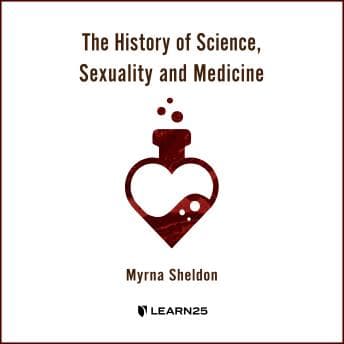

"The history of sexuality is not really about sex. It's about power."
That line hit me somewhere around hour two, stuck in BART delays because Caltrain was doing weekend maintenance. And honestly? It reframed everything I thought this course would be.
Not Your Undergrad Survey Course
Bottom Line: This is basically a systems architecture review, but for how Western science constructed sexuality as a category. Dr. Sheldon traces the dependencies - how colonial encounters, racial classification systems, and emerging medical institutions all became inputs into what we now treat as "natural" categories of sexual identity.
The ROI on this audiobook is high if you're the type who likes understanding why systems work the way they do. At 5.5 hours, it's dense but not bloated. Sheldon structures it like a good lecture series - each section builds on the previous, and she's careful to flag when she's introducing a new framework versus applying one you've already learned.
What surprised me: how much this is actually about epistemology. Before the 17th century, sexuality was primarily a theological concern. Scripture was the API. Then colonialism happened, Europeans encountered sexual and social practices that didn't fit their existing models, and suddenly you've got this massive dataset that the old system can't parse. So medicine and science step in as the new authority - not because they had better answers, but because they had better methods for categorizing difference.
The Author-Narrator Situation
Sheldon narrates her own work, which - look, this is always a gamble. Some academics are brilliant writers but monotone readers. She's... actually pretty good? Her teaching background shows. The pacing is measured, the emphasis lands where it should, and she doesn't do that thing where academics speed through their own material because they're bored of it.
That said, this is clearly a lecture recording, not a produced audiobook. No music, no sound design, just Sheldon and her material. If you need production polish, this isn't it. If you want a Harvard-trained historian walking you through primary sources and theoretical frameworks with genuine enthusiasm, you're in the right place.
I listened at 1.5x (my default) and it worked fine. The content is dense enough that 1.75x would probably require rewinds.
Who Should Listen (And Who Should Skip)
Perfect for: focused commutes, solo road trips where you want something that makes you feel smarter. This is a "dedicated listening" audiobook - you can't half-attention it while debugging.
Skip for: bedtime, gym, anything where you need to context-switch. The arguments build on each other, and missing a section means the next one won't land.
If you're coming from tech (like me), you'll appreciate how Sheldon treats science not as a neutral arbiter of truth but as a system with inputs, biases, and outputs shaped by its historical context. It's the same lens we apply to legacy codebases - understanding why decisions were made, even when those decisions look bizarre now. Accessory to War takes a similar approach to examining how scientific institutions get shaped by their historical contexts—in that case, military funding rather than colonial encounters.
If you're looking for a polemic or a hot take, this isn't it. Sheldon's approach is analytical, not activist. She'll explain why feminist and queer scholars are skeptical of purely biological definitions of sexuality, but she's more interested in tracing the genealogy of ideas than in telling you what to think.
The Gaps (Being Honest)
The research on this one is thin on listener reactions - it's an academic lecture series, not a bestseller, so there's not much community discourse to pull from. I can't tell you what the common complaints are because I couldn't find any.
What I can tell you: at 5.5 hours, this feels like a semester compressed. Some sections (especially the early modern European stuff) could've used more breathing room. And the US-centric focus in the latter half means if you're interested in non-American contexts, you'll want to supplement this elsewhere.
Worth Your Commute?
I finished this in three commutes plus one late-night insomnia session (thanks, on-call anxiety). It's the kind of material that makes you want to text someone "did you KNOW that..." at inappropriate hours. Kevin got several of these texts. He was less impressed than I was.
For anyone who's ever wondered why we treat sexuality as a biological fact rather than a historical construction - or why that distinction matters - this is a solid, well-argued primer. It won't change your life, but it might change how you think about a lot of things you took for granted.
The Margaret W. Rossiter Award isn't nothing. Sheldon knows her field, and it shows.