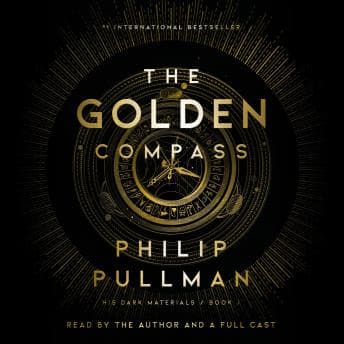

Look, I need to confess something. I first read The Golden Compass when I was twelve, hiding under my covers with a flashlight because my parents thought it was "too dark." (They weren't wrong, but also—that's the point?) So coming back to this as an audiobook felt like meeting an old friend who'd gotten a full theatrical makeover.
The Full Cast Experience Is Basically Audio D&D
Here's the thing about full cast audiobooks—they can go one of two ways. Either you get this immersive, almost tabletop-campaign-come-to-life experience, or it feels like everyone's reading from different rooms and nobody told them what scene they're in. This production? It's the former. Mostly.
Philip Pullman himself narrates, and honestly, hearing the author read his own world into existence hits different. There's this quality to his delivery—not performative, but like he's telling you a secret he's been keeping for years. The supporting cast brings distinct voices to each character, and when you've got armored bears and witch clans and daemons, you NEED that differentiation. Iorek Byrnison sounds exactly like an armored bear should sound, which is to say: terrifying and noble and like he could crush your skull but would rather discuss philosophy.
The sound effects and incidental music are well-deployed without being overbearing. It's not a radio drama exactly, but it's more than a straight narration. Think of it as... audiobook plus. The production quality is clean, which matters when you're trying to follow the political machinations of the Magisterium while also keeping track of which daemon belongs to which character.
Where Lyra's Oxford Becomes Real
Pullman's world-building is Sanderson-level good. I said it. The daemon concept alone—where every human has an external animal soul that can shapeshift until puberty—is the kind of magic system that makes you think "why didn't anyone else think of this?" And the audiobook format lets you marinate in these details. The descriptions of Lyra's Oxford, the frozen North, the Gyptian boats—they wash over you in a way that reading sometimes doesn't allow.
But here's where I have to be honest: the pacing in this full cast version can feel uneven. Some listeners have noted that the lines are spaced too far apart, and yeah, I noticed it too. There were moments where I wondered if my Bluetooth had glitched. It's not a dealbreaker, but if you're listening in a noisy environment (car with road noise, gym, etc.), you might miss transitions.
The emotional beats land hard though. When Lyra discovers the truth about what the Gobblers are doing to children—ugh. The narrators don't oversell it, which makes it worse somehow. And the ending? I won't spoil it, but I paused my thesis work for a solid hour afterward just staring at my screen. (Dr. Patel doesn't need to know about that.)
The Ruth Wilson Question
I should mention—there's apparently a solo narration version by Ruth Wilson that some listeners prefer. I haven't heard it, so I can't compare directly. But the consensus seems to be that if you want a more intimate, consistent experience, Wilson might be your pick. If you want the cinematic, almost theatrical approach, this full cast version delivers.
Personally? I loved the full cast. It reminded me of those nights in my D&D group's library sessions, where someone would narrate and others would voice the NPCs. That collaborative storytelling energy is here.
Roll for Initiative (Or Don't)
This is perfect for fantasy fans who appreciate detailed world-building and aren't afraid of a slower burn. It's technically a kids' book, but calling it that feels reductive. The themes—free will, religious authority, the nature of consciousness—are meaty enough for any adult. Skip it if you're impatient with pacing or if multiple narrators throw you off. Also maybe skip if you need something light and easy—this book asks you to pay attention.
At just under 12 hours, it's a solid investment but not overwhelming. I listened over about a week of commutes and evening coding sessions, and the chapter breaks work well for that kind of fragmented listening.
Campaign Notes
My D&D group would absolutely love this. Actually, I'm pretty sure our DM already stole the daemon concept for his homebrew campaign. The magic system is chef's kiss, the world feels lived-in rather than constructed, and Lyra is the kind of protagonist who makes terrible decisions for understandable reasons. That same lived-in quality is what makes The Amber Spyglass such a devastating conclusion to the trilogy—I'm both dreading and craving the reread. You know, like a real person.
Now if you'll excuse me, I have two more books in this series and a thesis that isn't going to ignore itself.